
Education Franchise Tax Benefits – A comprehensive Insight
Quick answer
The real education franchise tax benefits in India are not exemptions. A coaching or vocational training franchise is a commercial training service, so it pays 18% GST on course fees and on the franchise fee itself. The advantage comes from efficient structuring through four levers: GST input tax credit, 25% depreciation on the franchise fee, ordinary business deductions, and presumptive taxation.
Treat every figure below as general information and confirm your own position with a chartered accountant. Full sources are listed at the end. For the wider commercial picture, see our education franchise in India investor’s handbook.
If you are weighing the education franchise tax benefits worth claiming in India, the honest starting point is the one most articles skip: education does not mean tax free. Below, we separate the myth from the four mechanisms that actually lower your tax, show the numbers with sources, and flag the compliance traps that quietly inflate a franchisee’s taxable income.
Key takeaways
- No exemption: education franchises pay 18% GST on course fees and on the franchise fee itself.
- GST input tax credit lets a registered franchisee offset GST paid on the franchise fee, rent and equipment against GST collected on student fees.
- The franchise fee is depreciable at 25% as an intangible asset under Section 32 of the Income Tax Act.
- Ordinary business deductions cover rent, salaries, marketing, utilities and loan interest, but only if TDS is deducted correctly.
- Presumptive taxation (Section 44AD, renumbered as Section 58 from AY 2026-27) removes audit and bookkeeping load within turnover limits, and is barred for LLPs and companies.
Market and tax context at a glance
| Metric | Value | Source |
|---|---|---|
| India education sector | Over Rs 9 lakh crore (about USD 100 billion) | IBEF |
| India vocational training market, 2025 | About Rs 12,700 crore (USD 1,349.8 million) | IMARC Group |
| GST on coaching and on franchise fees | 18% | Notification 11/2017, SAC 999293 and 998396 |
| Depreciation on the franchise fee | 25% on written down value | Section 32, Income Tax Act |
Dollar figures converted to rupees at about Rs 94 per USD (September 2026). Market sizes are rounded.
The honest premise: why “tax-free” is a myth
Indian GST law exempts services provided by an educational institution to its own students only where that institution delivers recognised, formal qualifications, such as a school up to higher secondary or a degree-awarding college. A skilling, accounting, finance or exam-prep franchise falls under commercial coaching and training, taxed at 18% GST under service code SAC 999293.
Separately, the franchise fee and royalty you pay to the brand are classified as “trademarks and franchises” under SAC 998396, and also attract 18% GST. So the starting point is a fully taxable business.
About the phrase “tax benefits”
A taxable business is exactly the kind of business that gets to claim input tax credit and deduct its costs. The real benefits of an education franchise sit on the deduction side of the ledger, not the exemption side. Anyone selling you a “tax-free education franchise” is either mistaken or misleading you. Judge the structure, not the slogan.
The four real education franchise tax benefits
Every legitimate saving an education franchise owner can claim maps to one of four mechanisms. Treat these as a checklist for your chartered accountant, not as a promise of a specific outcome.
| Lever | Tax head | What it does |
|---|---|---|
| 1. Input tax credit | GST | Offset GST paid on the franchise fee, rent and equipment against GST collected on student fees |
| 2. Franchise-fee depreciation | Income tax | Write off the one-time franchise fee at 25% a year as an intangible asset |
| 3. Business deductions | Income tax | Deduct rent, salaries, marketing, utilities and loan interest |
| 4. Presumptive taxation | Income tax | Declare a flat percentage of turnover and skip audit and detailed books, within the limits |
Lever 1: GST input tax credit
This is the most under-used advantage. Because your franchise is a taxable service, once you are GST registered you can claim input tax credit (ITC) on the GST embedded in your business inputs, then pay the government only the difference. In an advance ruling on franchise agreements, the tax authority confirmed that franchise fees and royalty attract 18% GST and that the franchisee is eligible for input tax credit, subject to the usual conditions.
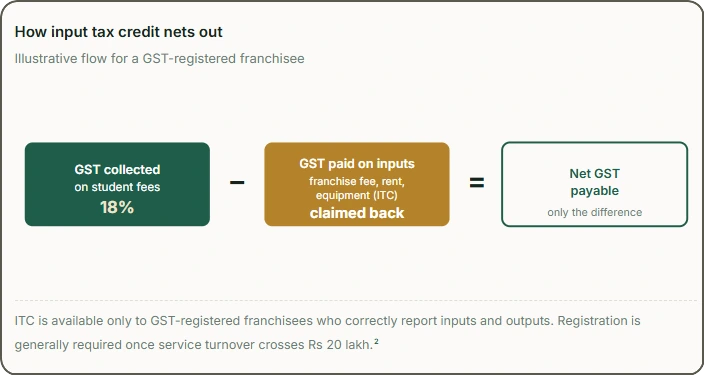
The practical takeaway: if you expect turnover comfortably above the Rs 20 lakh services threshold, voluntary early registration can turn the 18% on your franchise fee and setup costs into a recoverable credit rather than a cost.
One condition to watch: this assumes your output is fully taxable. If the same centre also delivers formally recognised, GST-exempt courses, input tax credit on common costs such as rent and the franchise fee cannot be claimed in full. It must be reversed in proportion to the exempt share under GST Rules 42 and 43.
Lever 2: depreciation on the franchise fee
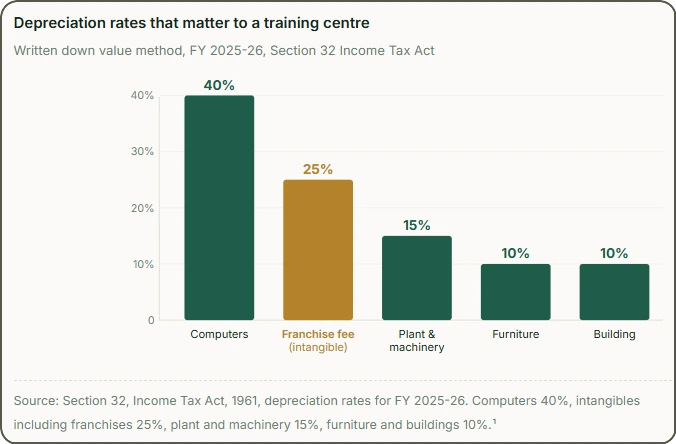
The single most overlooked income-tax benefit. A one-time franchise fee is not just an expense. Under Section 32(1)(ii) of the Income Tax Act, a franchise is expressly listed as an intangible asset alongside know-how, patents, trademarks and licences, and intangible assets are depreciated at 25% on the written down value.
This is settled, not theoretical. A tax tribunal has upheld depreciation at 25% on the capitalised cost of franchise rights, accepting that franchise rights are an intangible asset eligible for depreciation under Section 32(1)(ii). So the franchise fee reduces your taxable income year after year, on a declining balance, rather than being lost in year one. Your physical setup depreciates too, at higher rates for the assets a training centre actually buys.
Lever 3: ordinary business deductions
Running costs are deductible against income under the normal provisions of the Income Tax Act. For an education franchise, the recurring deductions typically include:
- Rent for the centre premises (Section 30).
- Salaries and stipends for faculty, counsellors and support staff.
- Royalty payments to the franchisor, once GST is separated out.
- Marketing and lead generation, including digital ads and local campaigns.
- Utilities, internet, software and maintenance under general business expenditure (Section 37).
- Interest on a business loan taken to fund the setup, deductible under Section 36(1)(iii).
None of these is unique to education. That is the point. The advantage of a franchise is that these deductions attach to a proven, documented cost structure, which makes the numbers easier to justify to both a lender and an assessing officer.
Lever 4: presumptive taxation (Section 44AD)
For a smaller single centre, presumptive taxation can cut compliance cost sharply. Under Section 44AD (renumbered as Section 58 under the Income-tax Act, 2025 from AY 2026-27), an eligible resident business can declare income at a flat 8% of turnover, or 6% for digital receipts, and skip audited books, provided turnover stays within Rs 2 crore, extended to Rs 3 crore where at least 95% of receipts are non-cash.
A coaching or training centre is treated as a business rather than a specified profession, so it can generally opt in. But eligibility is limited to resident individuals, HUFs and partnership firms: an LLP or a private limited company cannot use Section 44AD and must keep full books and be audited, whatever the turnover. This lever also cuts both ways, so read the warning under common mistakes before choosing it.
| Feature | Section 44AD (business) |
|---|---|
| Eligible entities | Resident individual, HUF, partnership firm. Not LLPs or companies |
| Turnover limit | Rs 2 crore, or Rs 3 crore if cash receipts within 5% |
| Deemed income | 8% of turnover, 6% on digital receipts |
| Books of account | Not required to maintain detailed books |
| Tax audit | Exempt when declaring at or above the deemed rate |
| Advance tax | 100% payable by 15 March of the financial year |
| Lock-in | Opting out early can bar re-entry for five years |
A worked example (illustrative only)
The figures below are illustrative round numbers to show how the levers interact. They are not a projection of any centre’s actual performance, and every real case depends on your own books and your advisor’s treatment.
| Line item | Regular books | Presumptive 44AD |
|---|---|---|
| Annual fee collection (turnover) | Rs 18,00,000 | Rs 18,00,000 |
| Rent, salaries, marketing, utilities | (Rs 9,60,000) | not itemised |
| Franchise-fee depreciation at 25% (on Rs 3,00,000) | (Rs 75,000) | not itemised |
| Equipment depreciation | (Rs 65,000) | not itemised |
| Taxable business income | Rs 7,00,000 | Rs 1,08,000* |
*Presumptive figure assumes 6% of turnover on fully digital receipts. Note the trap: if your real margin is genuinely above the deemed 6% to 8%, presumptive can understate income and save tax; if your real margin is thin, regular books with full deductions usually win. This is a calculation to run, not a rule of thumb.
Common mistakes that cost franchisees money
- Treating the franchise fee as a one-year expense. It is an intangible asset. Capitalise it and claim 25% depreciation each year, or you lose the multi-year benefit.
- Delaying GST registration. Wait too long and you cannot claim input tax credit on your largest setup costs, including the franchise fee.
- Choosing presumptive taxation blindly. If your actual profit margin is below the deemed rate, you pay tax on income you never earned. Model both before opting in.
- Assuming education means GST-exempt. Commercial coaching is taxed at 18%. Pricing your fees as if they were exempt erodes your margin.
- Claiming deductions without deducting TDS. Rent, royalty and professional fees are deductible only if you deduct and deposit TDS (Section 194I on rent, Section 194J on royalty and professional fees). Miss it and 30% of that expense is disallowed under Section 40(a)(ia), which quietly inflates your taxable income.
Which structure is most tax-efficient?
Deciding as an investor rather than a student? Read our companion guides on the which education franchise is most profitable and the best skill development franchise in India, learn why education franchises fail, then estimate returns with the franchise ROI calculator.
Frequently asked questions
Is an education franchise in India exempt from GST?
No. The GST exemption applies only to recognised formal schools and colleges. A coaching or vocational training franchise is a commercial training service taxed at 18% under SAC 999293, and the franchise fee and royalty are taxed at 18% under SAC 998396.
Can I claim depreciation on the franchise fee?
Yes. A franchise right is an intangible asset under Section 32(1)(ii) of the Income Tax Act, depreciated at 25% on the written down value. A one-time franchise fee can therefore be written off against taxable income over several years rather than expensed at once.
What is the GST input tax credit for a franchisee?
A GST-registered franchisee can offset the 18% GST paid on inputs such as the franchise fee, royalty, rent and equipment against the 18% GST collected on student fees, and pay only the net difference to the government.
Can an education franchise use presumptive taxation under Section 44AD?
Generally yes, because a training centre is treated as a business. Turnover must stay within Rs 2 crore, or Rs 3 crore if cash receipts are within 5%. It removes audit and bookkeeping load, but it can overstate income if your actual margin is below the deemed 6% or 8%. LLPs and companies cannot use it.
Which legal structure is most tax-efficient for a franchise?
It depends on scale. A sole proprietorship or partnership can use presumptive taxation and is simple to run at one centre. A private limited company or LLP gives liability protection and suits multi-centre operators, but neither can use Section 44AD: both must maintain full books and be audited regardless of turnover. This is a decision to take with a chartered accountant based on your projected turnover.
Do I lose deductions if I miss TDS on rent or royalty?
Yes, partly. Rent, royalty and professional fees are deductible only if you deduct tax at source and deposit it on time (Section 194I for rent, Section 194J for royalty and professional fees). If you fail to, 30% of that expense is disallowed under Section 40(a)(ia), which raises your taxable income for the year.
What is the GST on an education franchise fee?
The franchise fee and royalty paid to the brand are taxed at 18% GST under service code SAC 998396. A GST-registered franchisee can claim this as input tax credit against the GST collected on student fees, so it need not remain a sunk cost.
How is income from an education franchise taxed in India?
Income from an education franchise is taxed as business income. You can either maintain regular books and deduct expenses, depreciation and loan interest, or, if you are an eligible individual, HUF or partnership firm within the turnover limit, opt for presumptive taxation under Section 44AD and declare a flat 6% to 8% of turnover.
Sources and references
- Income Tax Department, Government of India. Section 32 (Depreciation), Income Tax Act, 1961, listing franchises as intangible assets. incometaxindia.gov.in
- Section 44AD presumptive taxation, turnover limits and rates for FY 2025-26 (AY 2026-27), consolidated as Section 58 under the Income-tax Act, 2025. cleartax.in
- GST on commercial coaching and training at 18% under SAC 999293, with the education exemption limited to recognised institutions (Notifications 11/2017 and 12/2017). gstclub.in
- Authority for Advance Ruling on franchise agreements: franchise fees and royalty classified under SAC 998396 at 18% GST, with input tax credit available to the franchisee. indialawoffices.com
- IMARC Group, India Vocational Training Market, valued at USD 1,349.8 million in 2025 (about Rs 12,700 crore at Rs 94 per USD). imarcgroup.com
- India Brand Equity Foundation (IBEF), Education Sector in India overview. ibef.org
- Income Tax Appellate Tribunal ruling upholding 25% depreciation on capitalised franchise rights as an intangible asset under Section 32(1)(ii). jurishour.in
- Section 40(a)(ia), Income Tax Act: 30% of interest, rent, royalty, professional or contract payments to a resident is disallowed if TDS is not deducted or not paid by the return due date. taxguru.in
This article is for general information based on the Income Tax Act, 1961 (and the Income-tax Act, 2025 for AY 2026-27) and GST provisions in force at the time of writing. Tax law changes with each Budget and depends on your legal structure, state and facts. Figures shown as illustrative are not projections of returns. Confirm your position with a qualified chartered accountant before acting.

LinkedIn: https://www.linkedin.com/in/sankar-chakraborty-38406844/
- Education Franchise Tax Benefits – A comprehensive Insight - September 24, 2026
- Skill Development Franchise for Placement: What the Data Really Says - August 28, 2026
- Why Education Franchises Fail: 6 Common Mistakes to avoid - August 21, 2026