
Why Education Franchises Fail: 6 Common Mistakes to avoid
Quick answer: A recognised brand lowers your odds of failure. It does not remove them. Most education centers that close in year one do not die from weak demand. They run out of cash while the batches are still filling. Four of the six mistakes below are entirely in the owner’s hands, which is the good news, because the ones you control are the ones you can solve before you sign.
India’s education market is projected to reach USD 313 billion by FY30, up from USD 117 billion in FY23 (IBEF). The demand is structural and it is not going away. And yet a training center can still shut within twelve months. When it happens, it is rarely a dramatic collapse. It is a slow squeeze that starts on day one and only becomes visible when the bank balance does. Here are the five patterns behind most of it.
| The numbers that matter | Figure |
|---|---|
| India education market by FY30 (IBEF) | USD 313 billion |
| Fixed-cost runway you should hold in reserve | ~9 months |
| Fatal mistakes that are yours to control | 4 of 6 |
First, about the failure numbers you keep seeing
Franchise sales decks love a clean statistic, usually some version of “franchises fail far less than independent businesses.” Most of those figures come from US sources, they are defined inconsistently, and researchers have been arguing over them for two decades. India does not publish a clean first-year closure rate for education franchises at all. So if someone hands you a precise failure percentage for this market, ask where it came from before you trust it.
What does hold up, everywhere, is simpler and more useful. A proven brand removes some of your risk and leaves the rest sitting with you. This article is about the part sitting with you.
The runway gap: where the cash actually goes
The mechanism behind most first-year closures is not complicated. Your fixed costs, rent, salaries and royalty, hit full rate the day you open. Your revenue does not. It ramps slowly as word spreads, as your first batches fill, and as your counselor’s pipeline builds. For several months the two do not meet, and the difference is real money that comes out of your pocket.
That gap between full-rate costs and ramping revenue is what people mean when they say a center “ran out of runway.” It is entirely predictable, and it is entirely fundable, if you plan for it before you open rather than discover it in month four.
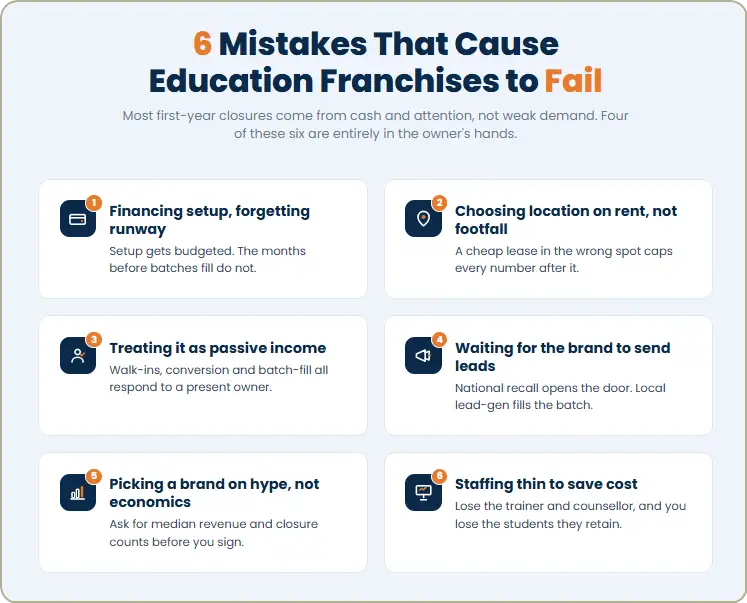
The 6 mistakes with solution
1. Financing the setup, forgetting the runway
Almost everyone budgets the fit-out, the signage, the first month’s rent. Far fewer budget for the gap between opening the doors and filling the batches. In those early months your revenue is a fraction of what it will settle at, but your fixed costs are already running in full.
Solution: keep roughly nine months of fixed costs in reserve, ring-fenced from your setup budget. Treat it as untouchable, not a buffer you dip into.
2. Choosing location on rent, not footfall
A cheap lease in the wrong spot is the most expensive decision on this list, because low walk-in volume quietly caps every number downstream of it. You cannot convert enquiries you never receive.
Solution: before you sign anything, spend a few days actually watching the catchment. Count the footfall, see what else pulls your kind of student to that area, talk to nearby businesses, and check how many similar centers already work that catchment, because two units fighting for the same students can starve both. Rent is easy to compare on a spreadsheet. Demand is not, which is exactly why people skip it.
3. Treating it as passive income
Three levers decide whether a center makes money: how many people walk in, how many the counsellor converts, and how full the batches run. Two of those three respond directly to how present the owner is. An absentee owner does not lose a little on each. Over a few months they lose all three at once, and by then it looks like a demand problem when it was really an attention problem.
Solution: put your name against at least two of the three levers before you open. If you intend to be hands-off, budget a full-time center manager from day one, not as a rescue hire once the numbers slip.
4. Waiting for the brand to send leads
National brand recall opens the door. It earns you the enquiry a no-name center would never get. But it does not fill your specific batches in your specific pin code. That is local work: your own Google presence, your own social posts, your own referral loops from existing students. centers that sit back and wait for head office to deliver every lead go hungry between enquiry cycles.
Solution: stand up local lead generation before your first batch, not after it stalls. Claim and optimize your Google Business Profile, keep a small always-on local ad budget running, and build a referral loop from your earliest students. Treat head-office leads as a top-up, never the whole pipeline.
5. Picking a brand on fee and hype, not economics
The franchise fee is the least important number in the deal. What matters is what a center like yours actually earns, and how many have quietly closed. So ask directly: what is the median revenue of centers that opened 24 to 36 months ago, and how many of that group are still open today? A franchisor who will not, or cannot, answer has just told you something worth knowing.
Solution: get the numbers in writing before you sign, and speak to two or three current partners head office did not hand-pick. If the median revenue, the closure count, or a partner introduction is vague or unavailable, treat that as your answer and walk.
6. Hiring the cheapest trainer, then losing the students they were meant to keep
A center lives or dies on two hires: the counsellor who converts the enquiry, and the trainer who keeps the batch enrolled through to completion. Owners who treat both as costs to shave tend to hire thin, hire late, or hire cheap. The damage does not show in month one. It shows up as dropouts, flat word of mouth, and a referral loop that never starts, which is the demand you already paid to generate leaking straight back out.
Solution: budget for a qualified counsellor and at least one trained trainer before you open, not after enrollments slip. Put your new hires through the franchisor’s faculty training so a capable but inexperienced person becomes competent fast, and track batch completion and student feedback every month, as early as you track walk-ins. In skilling, keeping your staff is how you keep your students.
Weak franchisor vs. Strong franchisor
| Factor | Weak franchisor | Strong franchisor |
|---|---|---|
| Track record | Few years, thin data | Decades of operating history |
| Demand engine | Franchisee finds own leads | Brand pull plus central marketing support |
| Curriculum | Stale, non-compliant | Owned and refreshed to current standards |
| Placement credibility | No employer relationships | Registered employer network |
| Transparency | Will not share closure data | Shares median revenue and closures |
| Faculty support | You recruit and train staff alone | Franchisor provides trainer and counsellor training |
| Course portfolio | Single course, demand dips off-season | Multiple programs that fill batches across the year |
Where ICA Edu Skills sits
ICA Edu Skills is built to take on the mistakes an owner cannot solve alone, and to leave with you the ones that should stay with you. Against the factors that decide a center’s first year:
- Lead generation is central. Campaigns are run by head office and leads route into the partner’s CRM, which helps with mistakes 2 and 4.
- Curriculum is owned and refreshed centrally, with certifications from NSDC, Microsoft, SAP and Zoho, so the offer stays relevant.
- Outcome support is built in. Placement assistance is backed by a database of 70,000-plus registered employers, which is what makes the promise credible when a parent asks the hard question. The job-guarantee structure applies specifically to the CIA and CIA Plus programs and is governed by those course-specific terms. It does not apply across the entire course catalogue.
- Faculty training is provided, alongside counselling scripts and operating systems, which is why prior education-sector experience is not a prerequisite.
- The program range works across the year. Faculty training and counselling scripts are provided, and the catalogue spans Tally, GST, Data Analytics and more, so a center is not depending on a single seasonal course to fill its batches.
The network context: 27 years of operation, 100-plus centers, over 6 lakh learners trained, and 70,000-plus registered employer partners. What ICA cannot do for you is hold your runway discipline or run your center day to day, mistakes 1 and 3. That part stays with you, and it should. No brand can want your center to succeed more than you do.
The verdict
The education franchise most likely to fail in year one is not the one in a weak market. It is the one where the owner budgeted the setup and not the runway, picked the location on rent, and then waited for the brand to do the work. Demand in Indian skilling is not the constraint. Cash discipline and active ownership are. Choose a franchisor that owns lead generation, curriculum and outcomes, keep nine months of fixed costs in reserve, and you have removed most of what actually kills a center.
Frequently asked questions
What is the biggest reason education franchises fail in year one?
Cash flow, not weak demand. Most of a new center’s early revenue goes straight to fixed costs like rent, salaries and royalty while the batches are still filling. Owners who budget for setup but not for several months of running costs run out of cash mid-ramp.
How often do education franchises fail?
There is no reliable India-specific first-year closure figure for education franchises, so treat any exact percentage you are quoted with caution. Most widely repeated franchise-failure statistics come from US sources, are defined inconsistently, and remain contested among researchers. What holds up is the principle, not the number: a proven brand reduces some risks but does not remove the ones the owner controls.
How much cash reserve should I keep before opening a center?
Plan to hold roughly nine months of fixed costs, ring-fenced from your setup budget. Rent, salaries and royalty run at full rate from day one, while revenue takes months to ramp. That gap is the single most common reason a new center stalls.
Can I run an education franchise as passive income?
Not well. Walk-in volume, counsellor conversion and batch-fill rate decide profit, and two of the three respond directly to how present the owner is. Absentee owners tend to lose all three over a few months, and it looks like a demand problem when it was really an attention problem.
How do I judge whether a franchisor is strong before signing?
Ask for the median revenue of centers that opened 24 to 36 months ago and how many of that group are still open. Check whether lead generation is central, whether the curriculum is owned and refreshed, and whether placement assistance is backed by a real employer network. A franchisor who will not share closure data has told you something worth knowing.
Do I need to hire staff before opening, or after enrollments grow?
Before. A center depends on two people from day one: a counsellor who converts enquiries and a trainer who keeps the batch enrolled to completion. Hiring either late means paying to generate leads you then fail to convert or retain. Use the franchisor’s training so a capable new hire ramps quickly, and track batch completion monthly from the start.
Investment and support details reflect publicly available information as of 2026 and vary by city and center size. Placement support is governed by course-specific terms. Job-guarantee provisions apply only to the CIA and CIA Plus programs as per those program terms. Franchise opportunities are subject to territory availability and eligibility.
Related articles:
- How Much Investment is Needed to Open an Education Franchise in India?
- Which Education Franchise Is Most Profitable in India? (2026 Investor Guide)
- Best Skill Development Franchise in India: 7 Options Compared (2026)
- Education Franchise Business in India: The Investor’s Handbook (2025–26)
- How to choose a most profitable education franchise in India?

LinkedIn: https://www.linkedin.com/in/sankar-chakraborty-38406844/
- Best Franchise Business in India: A Proven, Honest Guide - September 29, 2026
- Education Franchise Tax Benefits – A comprehensive Insight - September 24, 2026
- Skill Development Franchise for Placement: What the Data Really Says - August 28, 2026