
Computer Education Franchise: India’s Smart 2026 Bet
Quick answer: The computer education franchise that lasts in India is no longer one that teaches typing and MS Office. The durable model is job linked: computer plus accounting and compliance skills such as Tally, GST, SAP, MIS and Advanced Excel. Why does it last? Because every business, by law, must keep books and file GST, so the hiring never stops. This is the space ICA Edu Skills runs in.
Search “computer education franchise” and you will see the same promise everywhere: low cost, quick setup, your own centre. Here is the catch. Those listings tell you what you can start. They rarely tell you what will still earn three years from now, once a bigger brand drops prices below yours. India’s education market is large and still growing: it is expected to reach about ₹26 lakh crore by FY30 (IBEF puts this at USD 313 billion, Source: https://www.ibef.org/). Money is not the problem. The real question is which computer education franchise model actually holds on to it.
| The facts that matter | Detail |
|---|---|
| India education market by FY30 | About ₹26 lakh crore (IBEF: USD 313 billion) |
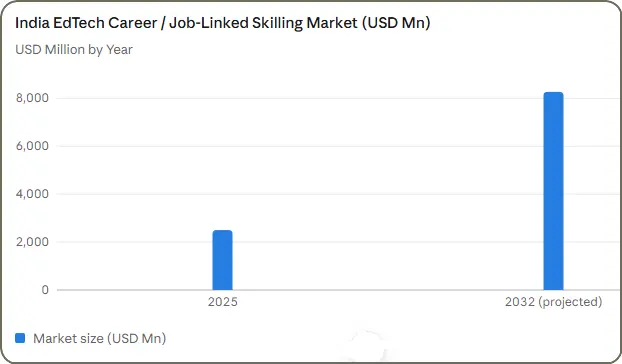
| Job-linked skilling market by 2032 | USD 8,266 million (Ken Research, 2025) |
| Graduate employability, 2025 | 54.81% (India Skills Report 2025) |
| Workforce with formal training | About 4.1% (Economic Survey / PLFS) |
| The model that lasts | Job-linked computer and accounting skilling |
What is a computer education franchise today?
A computer education franchise is a training centre you run under an established brand, using their course, systems and support. The old version sold basic software and certificates. The version that wins in 2026 sells employability: computer skills tied to the accounting and compliance work that companies are required to do. That single shift, from “software classes” to “job-ready skilling”, is what separates a centre that fills batches from one that quietly closes.
Popular computer education franchise programs
Most computer education franchises in India run some mix of these five program categories. They vary in demand durability, so it helps to know which fill batches year after year and which ride trends.
- Computer basics to advanced: foundation software, typing and office tools. Broad appeal and high footfall, a reliable entry course that feeds students into higher programs.
- Coding and programming: strong, well-paid demand, though it needs experienced trainers to stand out against online platforms.
- Digital marketing: fast-growing and practical, with steady demand from local businesses and agencies.
- Graphic design: popular and creative, strongest when run with a clear portfolio and placement focus.
- IT and networking fundamentals: hardware, networking and support skills that feed a wide base of back-office and IT support roles.
These programs build footfall and brand recall. What anchors a centre’s income over the long run is the job-linked, compliance-driven skilling that comes next.
Which computer education franchise model lasts the longest?
The job-linked model lasts longest, and the reason is plain. A business can stop advertising and stop hiring, but it cannot stop filing GST or keeping its books. The law requires it for as long as the business exists. So demand for people who can run Tally, handle GST, operate SAP and build MIS reports in Excel keeps going in good times and bad. A computer education franchise built on these skills rides demand that does not switch off.
The core gap is your pipeline. Graduate employability was just 54.81% in 2025 (India Skills Report), and only about 4.1% of India’s workforce has formal vocational training (Economic Survey, PLFS). Lakhs of commerce graduates leave college each year without the hands-on skills a job needs. That gap is the student line for a job-linked centre.
How the ICA Edu Skills Model Compares as a computer education franchise?
| Factor | Typical computer coaching franchise | ICA Edu Skills |
|---|---|---|
| Brand age | Often under 10 years | 27 years (established 1999) |
| Network | Local or regional | 100+ centres, 16 states, 61+ cities |
| Core offer | Basic software, typing, MS Office | Accounts, GST, Tally, SAP, MIS, Advanced Excel |
| Placement | Rarely structured | Placement support via 70,000+ registered employers* |
| Certifications | Local or none | NSDC, Microsoft, SAP, Zoho |
| Entry investment | Low, varies | ₹ 20 to 25 lakhs (indicative) |
Any model can work for the right person. But only the job-linked one survives a price war, because it competes on outcomes, not on being the cheapest class in town. It is also why so many low-cost centres fold early: see the common reasons education franchises fail before you sign anything.
Why does a job-linked computer education franchise win?
- The law keeps demand alive. Every registered business files GST and keeps books. Small firms run on Tally, large firms on SAP, and nearly every office needs MIS and Excel. These are daily work, not a passing trend.
- New students arrive every year. Lakhs of commerce graduates finish college annually, most without the skills employers actually hire for.
- The money comes in faster. Short, job-focused batches start earning sooner than a school ever could.
- Results market themselves. Every learner who lands a job brings the next few, so your batches get cheaper to fill.
- It scales. The same system works in any town, and smaller cities often have strong demand with few good institutes. That is an open door.
Who hires people with these skills?
A wide base of employers, all year, not just one kind of company.
| Who hires | Why they need these skills |
|---|---|
| CA, CS and tax firms | Steady need for accounts and GST support |
| Small and mid-size businesses | In-house staff for books and compliance |
| Factories and retail chains | Stock, payroll and reporting work |
| Banks, finance and insurance firms | Large teams for accounts and money work |
| BPO and back-office centres | Accounts and SAP users in volume |
| Startups and online stores | Small finance teams from day one |
| Accounts outsourcing companies | Hire year-round to serve overseas clients |
What jobs can students get after training?
Real roles that companies post every week: accounts executive, GST and tax assistant, Tally operator, SAP user, MIS executive, accounts payable and receivable executive, audit assistant, payroll executive and reporting assistant. These are hiring now, not far-off “future skills”.
Where ICA Edu Skills fits in
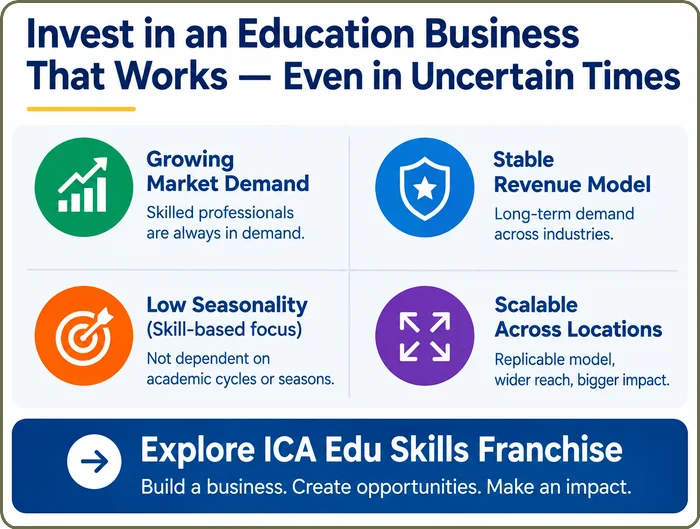
If a job-linked skilling centre is the strongest computer education franchise model, the next question is how to run one without building everything yourself. That is the gap a franchise fills, and where ICA Edu Skills works.
- The course is built and updated for you, with certifications from NSDC, Microsoft, SAP and Zoho, so what you teach stays relevant.
- Head office brings in the leads. Marketing runs centrally and leads route straight into the partner’s system.
- Placement help is built in, backed by more than 70,000 registered employers. The job guarantee applies only to the CIA and CIA Plus programmes, under those course terms, and does not cover the full course list.
- Trainer training is provided, with ready scripts and a simple way to run the centre, so no education background is required.
- Courses fill batches all year, from Tally and GST to SAP and Data Analytics, so you are not waiting on one seasonal course.
Investment and returns
The indicative entry is ₹ 20 to 25 lakhs for a 1,200 to 1,500 sq ft centre, covering the brand licence, interiors, technology and launch marketing. See the full franchise cost breakdown, then model your own payback with the ROI calculator before you commit. For the wider picture of how this sits against other options, compare the best franchise business in India.
Frequently asked questions
1. Is a computer education franchise profitable in India in 2026?
It is, when the model is job linked. Centres that teach accounts, GST, Tally, SAP, MIS and Excel track the fastest-growing skilling segment, unlike basic software coaching that competes only on price.
2. How much does a computer education franchise cost?
It varies by brand. The ICA Edu Skills entry is an indicative ₹ 20 to 25 lakhs for a 1,200 to 1,500 sq ft centre, depending on city and size.
3. Why are accounts, GST and Tally skills always in demand?
Because the work cannot be skipped. Every registered business keeps books and files GST. Small firms use Tally, large firms use SAP, and almost every office needs MIS and Excel. The work never stops, so the hiring never stops.
4. Do I need an education background to run one?
No. Your job is to run the business, hire good trainers and build local employer links. A franchise provides the course, trainer training and systems ready-made.
5. Should I start on my own or take a franchise?
On your own you control everything but must build the course, trainers and employer links yourself, which is where many new institutes struggle in year one. A franchise gives you all of that in return for a fee and following the system.
6. What jobs can students get after the training?
Accounts executive, GST and tax assistant, Tally operator, SAP user, MIS executive, accounts payable and receivable executive, audit assistant and payroll executive, across many kinds of companies.
Disclaimer:
The education market size is from IBEF (USD 313 billion by FY30). The ₹26 lakh crore figure is a rough conversion at current exchange rates, shown for easy reading only. Skilling market projection is from Ken Research (2025); employability from the India Skills Report 2025; vocational-training share from the Economic Survey and PLFS. Placement help follows course-specific terms. The job guarantee applies only to the CIA and CIA Plus programmes, as per those programme terms. Investment figures are indicative and franchise openings depend on area availability and eligibility.

LinkedIn: https://www.linkedin.com/in/sankar-chakraborty-38406844/
- Computer Education Franchise: India’s Smart 2026 Bet - October 27, 2026
- Top Education Business Ideas in India for Serious Entrepreneurs - October 13, 2026
- Best Franchise Business in India: A Proven, Honest Guide - September 29, 2026