
Top Education Business Ideas in India for Serious Entrepreneurs
Quick answer: The education business idea that lasts the longest in India is a skilling institute that teaches money and compliance skills: Accounts, GST, Tally, SAP, MIS and Advanced Excel. Why does it last? Because every business, by law, has to keep its accounts and file GST. That work never stops, so the need for trained people never stops either. This is the kind of business ICA Edu Skills runs.
Type “education business ideas” into Google and you will see the same list on almost every page: online tuition, a YouTube channel, a play school, a few hobby classes. Here is the catch. Those lists tell you what you can start. They almost never tell you what will still be making money three years from now, once the excitement fades and a bigger player drops prices below yours. India’s education market is large and still growing fast. It is expected to reach about ₹26 lakh crore by FY30 (IBEF puts this at USD 313 billion, Source: https://www.ibef.org/industry/education-sector-india). So money is not the problem. The real question is simple: which idea actually holds on to it?
| The facts that matter | Detail |
|---|---|
| India education market by FY30 | About ₹26 lakh crore (IBEF: USD 313 billion) |
| The idea that lasts | A skilling institute for money and compliance skills |
| Skills always in demand | Accounts, GST, Tally, SAP, MIS, Advanced Excel |
| Why the demand stays | This work is required by law. It cannot be skipped. |
What is an education business?
An education business is any business that teaches or trains people for a fee. In India that covers a lot: coaching centers, exam prep, play schools, online tuition, course content for apps and skill training institutes. They all look similar from the outside. But they are very different in one way that matters most: does the demand stay strong when people have less money to spend?
Which education business idea lasts the longest?
A skilling institute that teaches money and compliance skills lasts the longest. The reason is plain. A business can stop advertising. It can stop hiring. But it cannot stop filing GST or keeping its books. The law says it must, for as long as it exists. So the demand for people who can do this work keeps going, good times or bad.
A simple test: four questions before you spend a rupee
Before you fall in love with any idea, run it through these four questions.
- Will people always need it, or is it the first thing they cut? Some needs never go away, because the law or the business forces them. Others, like a weekend hobby class, are the first to go when money is tight.
- How soon will cash come in? A short, job-focused course can fill a batch and finish in a few months. A big school can take years before it earns back what you put in.
- Can anyone copy it tomorrow? A spoken-English class from your drawing room is easy to start, which is exactly why everyone starts one and the prices crash. Skills that are harder to copy protect your income.
- Does it run without you in the room? If it only works when you are the one teaching, you have made a job for yourself, not a business.
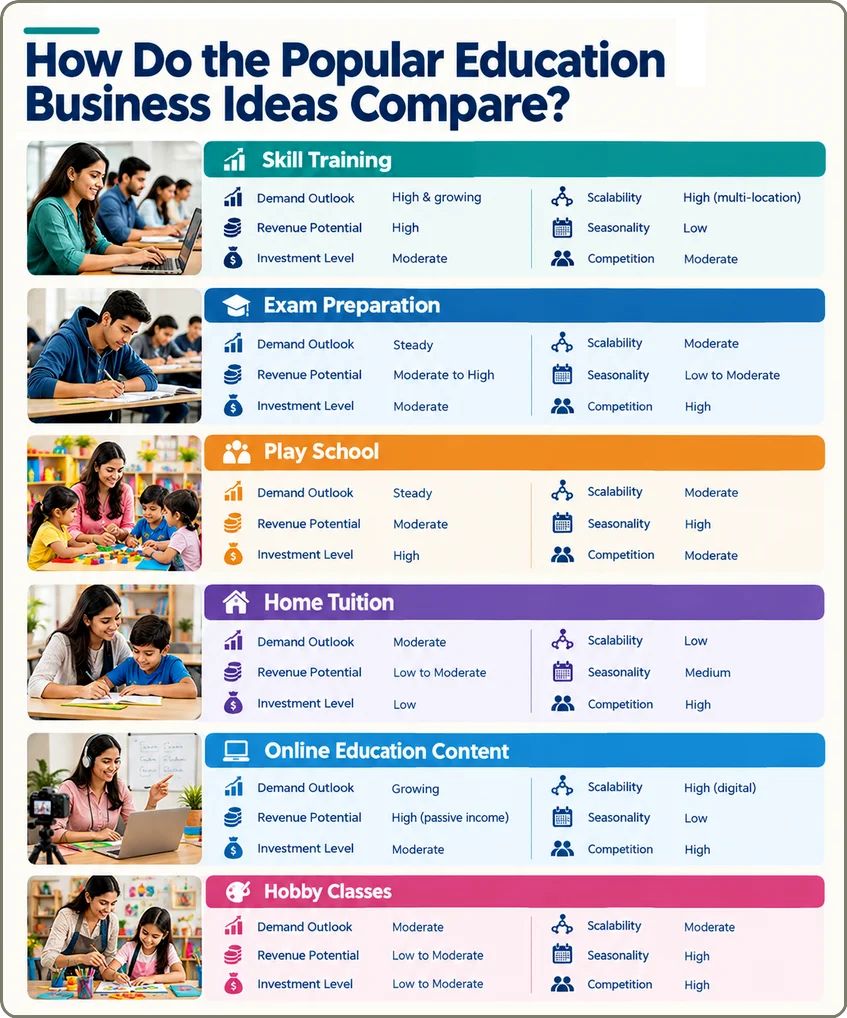
How do the popular education business ideas compare?
| Idea | Will demand stay? | How fast is the money? | Easy to copy? | Can you open more branches? | Our take |
|---|---|---|---|---|---|
| Skilling institute (money & compliance skills) | Yes, always | Fast | No, hard to copy | Yes | Strongest |
| Exam / test prep coaching | Mostly | Medium | Somewhat | Hard | Works with a clear niche |
| Play school / daycare | Yes | Slow | Somewhat | Yes | Heavy cost, long wait |
| Online tuition / home tuition | Can dip | Fast | Very easy | No | Good start, weak business |
| Education YouTube / content | Can dip | Slow | Very easy | No | A channel, not a business |
| Hobby / activity classes | Cut first | Medium | Very easy | Hard | Depends fully on you |
Any of these can work for the right person. But only one passes all four questions with ease.
Why is a skilling institute the strongest idea?
- The law keeps the demand alive. Every business has to file GST and keep its books, so there is always a need for people who can do it. Most small firms run on Tally. Most big companies run on SAP. And almost every office job needs MIS reports and Excel. These skills are not a passing trend. They are daily work.
- New students arrive every year. Lakhs of commerce graduates finish college each year, and most of them step out without the hands-on skills a job actually needs. That gap is your student line.
- The money comes in quickly. Short batches mean you start earning sooner, and you learn fast what the market wants.
- Happy students bring more students. Every learner who lands a job tells friends and family. So your next batch costs you less to fill.
- It is easy to grow. The same simple system works in any town, which makes it easy to open more branches or run it as a franchise. Smaller cities often have strong demand and very few good institutes, which is an open door.
Who hires people with Accounts, GST, Tally, SAP, MIS and Excel skills?
Lots of people, all the time, and not just in one kind of company.
| Who hires | Why they need these skills |
|---|---|
| CA, CS and tax firms | Steady need for accounts and GST helpers |
| Small and mid-size businesses | In-house staff to handle books and compliance |
| Factories and retail chains | Stock, salary and report work |
| Banks, finance and insurance firms | Large teams for money and accounts work |
| BPO and back-office centers | Accounts and SAP users in big numbers |
| Delivery, online stores and startups | Small finance teams from day one |
| Accounts outsourcing companies | Hire all year to serve clients abroad |
What jobs can students get after this training?
Real jobs that companies post every week: accounts executive, GST and tax assistant, Tally operator, SAP user, MIS executive, accounts payable and receivable executive, audit assistant, payroll executive and data or reporting assistant. These are not far-off “future skills.” They are hiring right now.
How do you start and run this business?
- Build your course around what local companies actually hire for. Do not just teach theory and hope. Ask the firms and shops near you what they look for, then teach exactly that: real GST entries, live Tally practice, simple MIS reports, hands-on SAP, and Excel the way offices really use it.
- Hire good trainers. They are your real product. In skill training, a trainer with real work experience matters more than any flashy ad.
- Treat jobs for students as a proper job, not a favour. Set up a small placement team, build links with local employers, and run mock interviews. This is where most small institutes quietly fail.
- Market locally and online together. A Google Business Profile, a simple website that shows results, and good word of mouth beat expensive random ads.
- Decide early: on your own, or a franchise? Building the course, the trainers and the employer links from scratch is slow and costly. A franchise gives you all of that ready-made, in return for a fee and following their system.
What are the risks?
Be honest about these. You depend a lot on your trainers, so losing a good one hurts. Getting students placed takes real, steady effort. In big cities there can be plenty of competition. And word spreads fast, so a few weak batches can damage your name quickly. All of this can be managed, and a good franchise exists mainly to take these very risks off your plate.
Where ICA Edu Skills fits in
If a skilling institute is the strongest education business idea, the next question is how to run one without building everything yourself. That is exactly the gap a franchise fills. ICA Edu Skills works in this space.
- The course is built and updated for you, with certificates from NSDC, Microsoft, SAP and Zoho, so what you teach stays useful.
- Head office brings in the leads. Marketing is run centrally, and the leads come straight into the partner’s system.
- Help with jobs is built in, backed by a list of more than 70,000 registered employers. The job-guarantee part applies only to the CIA and CIA Plus programs, under those course terms. It does not cover the full course list.
- Trainer training is provided, along with ready scripts and a simple way to run the center, so you do not need an education background to start.
- The courses fill batches all year, from Tally and GST to SAP and Data Analytics, so you are not stuck waiting for one seasonal course.
The bottom line
The education business most likely to fail is not the one in a weak market. It is the one built on a need people drop the moment money gets tight. The idea that lasts is the opposite: a skilling institute whose demand is tied to work that businesses are required by law to do. Pick a model with steady demand, a ready-made course and real help with jobs, and you build something that keeps earning, not just a job for yourself.
Frequently asked questions
1. Which education business has the most steady demand in India?
One built on skills that businesses are required to use. Training in accounts, GST and Tally is a strong example, because every business has to keep books and file GST no matter how the economy is doing.
2. Can I start an education business with low investment?
Yes. A skilling institute mainly needs trainers, a classroom or computer lab, and software. It does not need land or big recognition, so the starting cost is far lower than a school. A franchise can lower the effort even more.
3. Why are accounting, GST and Tally skills always in demand?
Because the work cannot be skipped. Every registered business must keep books and file GST. Most small firms use Tally, big firms use SAP, and almost every office needs MIS and Excel. The work never stops, so the hiring never stops.
4. Should I start on my own or take a franchise?
On your own, you control everything, but you must build the course, the trainers and the employer links yourself. That is where many new institutes struggle in the first year. A franchise gives you all of that ready-made, in return for a fee and following their system.
5. Do I need to be a teacher to run a skilling institute?
No. Your job is to run the business, hire good trainers and build links with local employers. Knowing the subject helps, but it is not a must.
6. What jobs can students get after accounts and GST training?
Accounts executive, GST and tax assistant, Tally operator, SAP user, MIS executive, accounts payable and receivable executive, audit assistant and payroll executive, across many kinds of companies.
Disclaimer:
The market size is from IBEF (USD 313 billion by FY30 and USD 117 billion in FY23). The rupee figures of about ₹26 lakh crore and ₹10 lakh crore are rough conversions at current exchange rates and are shown for easy reading only. Help with jobs follows course-specific terms. The job-guarantee applies only to the CIA and CIA Plus programs, as per those program terms. Franchise openings depend on area availability and eligibility.

LinkedIn: https://www.linkedin.com/in/sankar-chakraborty-38406844/
- Top Education Business Ideas in India for Serious Entrepreneurs - October 13, 2026
- Best Franchise Business in India: A Proven, Honest Guide - September 29, 2026
- Education Franchise Tax Benefits – A comprehensive Insight - September 24, 2026