
Best Franchise Business in India: A Proven, Honest Guide
Quick Answer: There is no single best franchise business in India, because the right choice depends on your capital, your city and how much daily operating load you want to carry. For most first-time and mid-budget investors, service-led education and skills training is the strongest category: demand holds steady in a downturn, capital at risk is lower than food or organized retail, and government policy actively supports it. Food and QSR (Quick Service Restaurant) remain the largest category by revenue, while logistics offers the lowest entry point. This guide compares every major franchise category, breaks the options down by budget, and shows you how to evaluate a franchise before you sign.
Choosing the best franchise business in India in 2026 is a decision about category, capital and risk, not about which logo is most famous. India is now the second largest franchise market in the world, and more brands are looking for partners than at any point in the past decade. This guide gives you the full picture so you can shortlist with confidence.
Table of contents
- The India franchise market in 2026
- What the best franchise business in India really means
- The best franchise business in India by category
- The best franchise business in India by budget
- Franchise vs starting from scratch
- Why the skills category is quietly the strongest
- How to evaluate a franchise before you sign
- Where ICA Edu Skills fits
- The verdict on the best franchise business in India
- Frequently asked questions
The India franchise market in 2026
India is the second largest franchise market in the world after the United States, with more than 4,600 active franchisors and close to two lakh outlets run by roughly 1.7 lakh franchisees. The sector is reported to be growing at 30 to 35 percent a year, faster than the wider retail economy. Understanding this market is the first step to choosing the best franchise business in India for your budget and city.
One number confuses new investors, so it is worth clearing up. India’s franchise sector is valued at roughly US$9.6 billion when you measure only royalties and fees, but estimates of total franchised system sales run far higher, in the US$140 to 150 billion range. The gap is not a contradiction. It reflects what you are counting: the franchisor’s cut versus the whole revenue passing through franchised outlets.
The growth is being driven from the bottom up. Tier-2 and tier-3 cities such as Indore, Jaipur, Lucknow and Guwahati are now among the fastest expanding franchise markets, and in a higher interest-rate environment brands increasingly prefer capital-light, franchisee-funded expansion over company-owned stores.
What the best franchise business in India really means
Most “best franchise” lists rank brands. That is the wrong unit of analysis. Within any list of top franchises, outcomes vary enormously by category, location and operator. A brand that thrives in a metro food court can fail on a tier-3 high street, and two franchisees of the same brand can post very different results.
So the best franchise business in India for you is not a single famous name. It is the category that fits your capital, your city and your appetite for daily operations, and then the brand inside that category with the strongest model. This guide compares categories first, then narrows to the segment most first-time investors overlook.
The best franchise business in India by category
Investment needs, space and operating intensity differ sharply across sectors. This is the map most lists skip.
| Category | Typical investment | Space | Profile and risk |
|---|---|---|---|
| Education and skills | Rs 5 lakhs to 25 lakhs | Low to medium | Service led, recurring demand, lighter infrastructure, policy support |
| Food, QSR and cafe | Rs 15 lakhs to 60 lakhs and above | Medium to high | Largest category by revenue, high operating and working-capital load |
| Healthcare and diagnostics | Rs 10 lakhs to 60 lakhs and above | Medium | Essential-service demand, regulatory and operational complexity |
| Beauty and salon | Rs 10 lakhs to 30 lakhs | Medium | Repeat customers, location and staff quality are critical |
| Laundry and garment care | Rs 8 lakhs to 35 lakhs | Low to medium | Recurring local demand, service business |
| Logistics and courier | Rs 2 lakhs to 15 lakhs | Low | Lowest entry point, highly location dependent |
| Retail and grocery | Rs 20 lakhs to 1 crore and above | High | Established demand, heavy inventory and intense competition |
| Fitness and wellness | Rs 20 lakhs to 1.5 crore and above | High | Growing demand, large space and equipment costs |
Source: Ranges compiled from publicly disclosed franchise figures and industry benchmarks (Franchise India, FranchiseBazar), 2026. Figures vary by city, format and center size, and change over time. Verify current numbers directly with each franchisor before shortlisting.
Food and beverage remains the single largest category by revenue, contributing over 30 percent of franchise industry sales. But largest is not the same as best for you. Higher revenue in food comes tied to higher rent, staffing and daily perishable risk, which compresses margins for a first-time operator.
The best franchise business in India by budget
The most useful way to shortlist is by the capital you can commit, including working capital and not just the franchise fee. Here is what the best franchise business in India looks like at each budget level.
Under Rs 10 lakhs
The low-investment tier favours service models that avoid heavy real estate and inventory. Common options are logistics and courier pickup points, home-service and cleaning franchises, and small vocational or coaching centers. Logistics has the lowest entry cost but is highly dependent on catchment and volume.
Rs 10 lakhs to Rs 25 lakhs
This is the busiest and most competitive band. It covers most education and skills franchises, mid-tier beauty and salon formats, laundry chains and smaller food outlets. Faster break-even and scalable formats make this range attractive to first-time investors.
Rs 25 lakhs to Rs 1 crore
At this level you enter full-format food and QSR, larger retail, diagnostics and preschool or K-12 education. Returns can be strong, but fixed costs, staffing and working capital rise sharply, so operating discipline matters more than the brand name.
Above Rs 1 crore
Large retail, fitness centers and multi-unit food deals sit here. These suit experienced operators or investors treating the franchise as a managed asset rather than an owner-run business.
Narrowing to education specifically? Compare returns in which education franchise is most profitable, or see the shortlist in best skill development franchise in India.
Franchise vs starting from scratch
A franchise is not automatically safer than an independent business. It is a trade. You gain a tested model, training, supply chains and brand recognition, which reduces some early-stage risk and shortens the learning curve. In return you give up flexibility, pay an upfront fee and ongoing royalties, and operate inside the franchisor’s rules.
The model works best when the brand genuinely adds value you could not build alone: recognized credentials, a proven curriculum, national marketing or a supply advantage. When you weigh a franchise against going independent, that added value is what separates the best franchise business in India from paying mainly for a name while carrying all the operating risk yourself.
Why the skills category is quietly the strongest
One category rewards patient investors more than the headlines suggest, and it is a strong contender for the best franchise business in India: professional skills and education. Demand is recession-resistant because Indians keep investing in employability whether the economy is rising or falling. The tailwind is structural, not seasonal.
The International Labour Organization projects that India could face a shortage of around 29 million skilled workers by 2030, and the government’s Skill India mission continues to fund training infrastructure through the National Skill Development Corporation. Education and training is already one of the largest categories in Indian franchising. Skill and vocational formats also need less real estate and inventory than food or retail, which lowers the capital you put at risk and speeds up break-even.
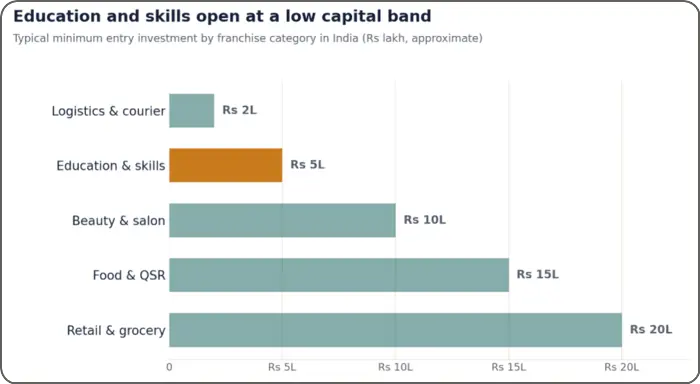
Chart: Typical minimum entry investment by category. Education and skills sit at a low capital band while offering recurring demand. Source: Franchise India and FranchiseBazar disclosures, 2026.
| Sub-segment | Typical investment | Note |
|---|---|---|
| Vocational and professional skills | Rs 5 lakhs to 25 lakhs | Adult upskilling, strong government policy support, lower fixed cost |
| Coaching and tutoring | Rs 5 lakhs to 20 lakhs | Local demand, high competition |
| Preschool and K-12 | Rs 25 lakhs to 1 crore and above | Higher real estate and fixed cost |
Source: Franchise India education vertical; National Skill Development Corporation (NSDC) policy targets, 2026.
How to evaluate a franchise before you sign
This is the step most investors rush, and it is where the real risk sits. Before you commit to what looks like the best franchise business in India for your situation, know this: India has no dedicated franchise-specific disclosure law like the United States FTC Franchise Rule. Franchising is governed by general laws such as the Indian Contract Act, trademark and intellectual property law, and competition law. In practice, the burden of due diligence falls almost entirely on you.
Reliable franchisors still voluntarily share a franchise disclosure document, usually 15 to 30 days before any signature or payment. Treat the absence or delay of one as a warning, not a formality. Work through this before committing:
- Verify the basics. Confirm the franchisor’s legal registration and that it actually owns the trademark and intellectual property it is licensing to you.
- Read the full agreement and disclosure document. Check fees, royalties, territory rights, renewal and exit terms. Consider a franchise lawyer for a document that can run to hundreds of pages.
- Talk to existing and former franchisees. Their experience is the single most honest data source you have. Ask directly about support, timelines and disputes.
- Check franchisee turnover. A high rate of partners leaving or not renewing is a strong signal that the unit economics do not work.
- Study the litigation history. A pattern of disputes between the franchisor and its partners is a serious red flag.
Five red flags to walk away from
- Pressure to sign or pay quickly, or a refusal to answer normal due-diligence questions.
- Vague or missing financial information and no disclosure document.
- The franchisor discourages or blocks you from contacting existing franchisees.
- Guarantees of specific income or returns, which no honest franchisor can promise.
- Unclear territory protection, so a second outlet could open next to yours.
For education franchises, run a structured check on the outcome claims specifically. Use the 7 point franchise placement audit checklist and understand the ownership structures in FOFO vs FOCO vs COCO franchise models.
Where ICA Edu Skills fits
The vocational and professional skills segment is exactly where ICA Edu Skills operates, and it is the kind of category-and-brand fit this guide argues you should look for: a genuine credential and proven curriculum, not just a name. An ICA center opens in the Rs 20 lakhs to 25 lakhs range, needs 1,200 to 1,500 sq ft, and requires no prior education background.
Against the things that usually get cut at the lower end of the market:
- Lead generation is central. Campaigns are run by head office and leads route into the partner’s CRM.
- Curriculum is owned and stacked. Courses carry certifications from NSDC, Microsoft, SAP and Zoho, built and refreshed centrally.
- Outcome support is built in. Placement assistance is backed by a database of 70,000-plus registered employers. The job-guarantee structure applies specifically to the CIA and CIA Plus programs and is governed by those course-specific terms. It does not apply across the entire course catalogue.
- Faculty training is provided, alongside counselling scripts and operating systems, which is why prior education-sector experience is not a prerequisite.
The network context: 27 years of operation, 100-plus centers, and over 6 lakh learners trained.
Go deeper before you decide. Read the education franchise business in India handbook for segment-by-segment economics, or work through how to choose a most profitable education franchise.
The verdict on the best franchise business in India
For a first-time or mid-budget investor, the best franchise business in India is rarely the most famous brand or the cheapest entry. It is the category with durable demand, the model whose entry cost still leaves you twelve months of working-capital runway, and the franchisor that keeps lead generation, curriculum and outcomes on its side of the table rather than yours.
Judged on those tests, the vocational and skills segment stands out: recession-resistant demand, government policy support, and a lower capital band than food or retail. It is not the only good answer, but it is the one most shortlists overlook, and the one worth putting at the top of your list for 2026.
Frequently asked questions
Which is the best franchise business in India in 2026?
There is no single best franchise for everyone. For most first-time and mid-budget investors, service-led education and skills training is the strongest category, because demand stays steady in a downturn and the capital needed is lower than food or organized retail. Food and QSR remain the largest category by revenue, while logistics offers the lowest entry point. The best choice matches your budget, city and appetite for daily operations.
What is the most profitable franchise in India?
Profitability depends on category economics and location, not brand fame. Vocational and professional skills franchises are often cited as the most profitable education category because they combine recurring demand, policy support and lower fixed costs. Food franchises can earn higher revenue but carry higher rent, staffing and working-capital loads that compress margins.
How much does it cost to buy a franchise in India?
Entry investment ranges from roughly Rs 2 lakhs for some logistics formats to Rs 5 crore or more for large food outlets. Education and skills franchises commonly start between Rs 5 lakhs and Rs 25 lakhs. Always budget for working capital, not just the franchise fee.
Which franchise is best for low investment in India?
For budgets under Rs 10 lakhs, logistics and courier pickup points, home-service and cleaning franchises, and small vocational or coaching centers are the most common options. They keep real estate and inventory costs low, though logistics is highly location dependent.
Is a franchise safer than starting from scratch?
A franchise gives you a tested model, training and brand recognition, which lowers some early-stage risk. It is not a promise of profit. You also give up flexibility and pay ongoing royalties. Location, execution, category demand and the terms of the agreement still decide the outcome.
Is there a franchise disclosure law in India?
India has no dedicated franchise-specific disclosure law like the United States FTC Franchise Rule. Franchising is governed by general laws such as the Indian Contract Act, trademark and intellectual property law and competition law. This makes independent due diligence essential. Reliable franchisors still share a franchise disclosure document, typically 15 to 30 days before signing.
Why is education a good franchise category in India?
India faces a large skills gap, with the ILO (International Labour Organization) projecting a shortage of about 29 million skilled workers by 2030. Government programs such as Skill India keep funding training, while skill formats need less space and inventory than food or retail. That combination gives the category durable demand and lower capital at risk.
Investment figures reflect publicly disclosed ranges as of 2026 and vary by city, center size and brand. This article is general information and not investment, legal or financial advice, or any promise of returns. Placement support is governed by course-specific terms, and job-guarantee provisions apply only to the CIA and CIA Plus programs as per those program terms. Franchise opportunities are subject to territory availability and eligibility. Review the franchise disclosure document and agreement, and consult a qualified advisor, before investing.
Related articles
- Which Education Franchise Is Most Profitable in India? (2026 Investor Guide)
- Best Skill Development Franchise in India: 7 Options Compared (2026)
- Education Franchise Business in India: The Investor’s Handbook (2025-26)
- How Much Investment is Needed to Open an Education Franchise in India?
- How to choose a most profitable education franchise in India?

LinkedIn: https://www.linkedin.com/in/sankar-chakraborty-38406844/
- Best Franchise Business in India: A Proven, Honest Guide - September 29, 2026
- Education Franchise Tax Benefits – A comprehensive Insight - September 24, 2026
- Skill Development Franchise for Placement: What the Data Really Says - August 28, 2026