
FOFO vs FOCO vs COCO Franchise Models: Which is better?
If you are weighing your first franchise, you have almost certainly seen these three acronyms thrown around as if they are three options you get to pick from. They are not. Here is what they actually mean — and where the real decision lies.
Quick Answer:
There is no single “best” model — the right one depends on how hands-on you want to be. First, COCO (Company Owned, Company Operated) is not an option, because the company owns and runs its own outlet. Your real choice is between two: FOCO (you invest, the company runs it) is better if you want to stay hands-off, while FOFO (you invest and run it yourself) is better if you want control and higher profit. For most first-time investors in India, a supported FOFO – where the brand handles the hardest parts for you — is the smartest choice.
Two of these three are not really your decision. You cannot buy into a COCO outlet — it is the company’s own store, run on the company’s own money. So COCO belongs in your due diligence, not your shortlist: a brand that scaled its own centers profitably before selling franchises has proven the model with its own capital. If a brand rushes to franchise before it can run its own units, ask why.
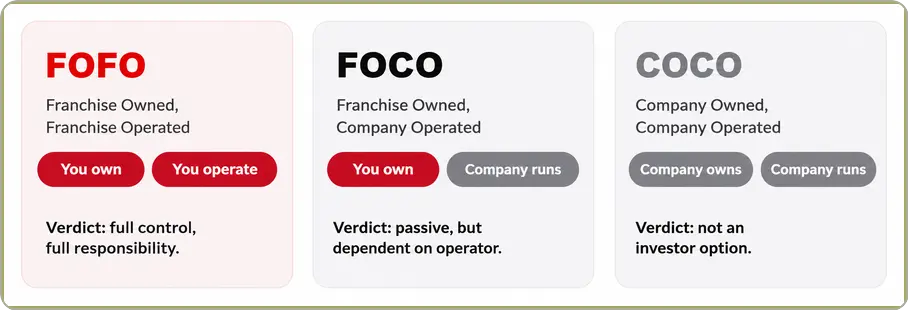
Decoding the three models
FOFO — Franchise Owned, Franchise Operated. You fund the setup and run daily operations: hiring, delivery, local marketing, sales. The franchisor supplies the brand, the product or curriculum, systems and training. Highest control, highest effort — and you keep the upside after royalty.
FOCO — Franchise Owned, Company Operated. You fund the capital; the company manages staffing and day-to-day running, usually against a revenue share or an agreed return. Lower effort, lower control — and your outcome now rides almost entirely on the operator’s competence and honesty.
COCO — Company Owned, Company Operated. The brand owns and runs it. No franchisee, no external check. Treat it as the benchmark for how well the model performs, not as a way in.
| Model | Who invests | Who operates | Your control | Your effort | Best for |
|---|---|---|---|---|---|
| FOFO | You | You | High | High | Hands-on owners who want to build and keep the upside |
| FOCO | You | The company | Low | Low | Passive investors who trust the operator and want distance |
| COCO | The company | The company | None (you’re out) | None | Not applicable — this is the brand’s own outlet |
The India context: Why first-time investors prefer a franchise
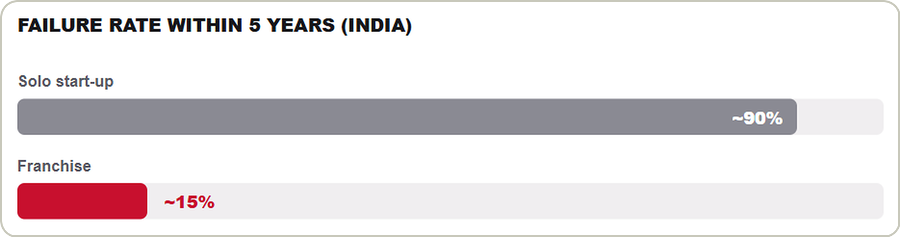
Franchising is booming in India. It is now the second-biggest franchise market in the world after the United States, with over 4,600 brands and around 2 lakh outlets, and it has been growing 30–35% every year.[1] The reason people choose it is simple: it is safer than starting a business from scratch. A well-known 2016 IBM–Oxford study found that about 90% of new start-ups in India shut down within five years, while only about 15% of franchises do.[2] With a franchise, the brand has already worked out the hard parts, so you are not figuring everything out alone.
FOFO or FOCO: which one should you pick?
FOCO sounds easy — “you put in the money, we run it, you just collect the profit.” But there is a catch. You hand over all control, so your success now depends completely on how well the company runs your outlet. If they manage it badly or are not fully honest about the numbers, you can lose money and there is little you can do about it. FOFO is the opposite: you have to run the business yourself. Many first-timers say yes to this without realizing how much work it really is.
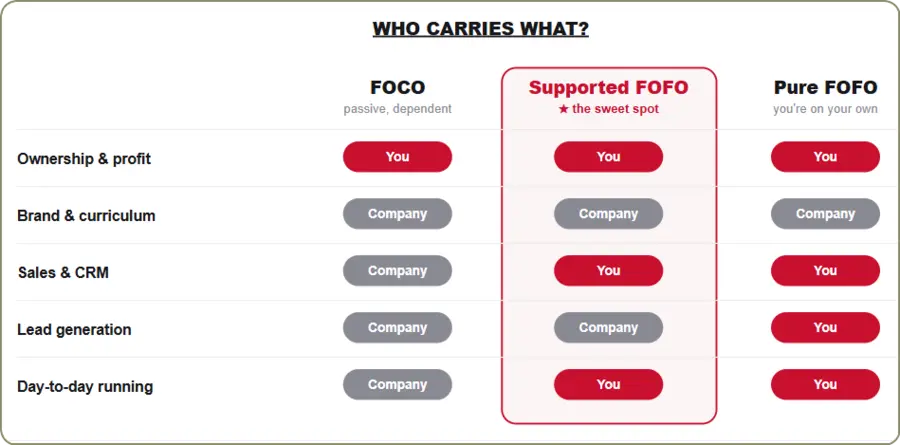
The best option for most beginners sits in the middle: a FOFO model where the brand takes care of the hardest jobs for you — the course content or product, the sales process, the software to track leads, and the marketing that brings in customers. You still own the business and keep the profit, but you are not left to manage everything on your own.
How the ICA Edu Skills franchise works
The ICA Edu Skills franchise is exactly this kind of “middle” option. It is a FOFO model — you own and run the center — but ICA supports you with all the difficult parts. Running since 1999, ICA has 100+ training centers, a network of 70,000+ recruiters, and has trained 6 lakh+ students in accounting, finance, Tally, GST, SAP and data analytics. As a partner, you get:
- Ready curriculum & teaching tools — no course-building from scratch.
- Counsellor training, scripts and CRM — a proven lead-to-enrollment conversion.
- Centralized digital marketing & lead generation — microsites, Google Business Profile, landing pages, ad creatives and campaigns.
- A recession-resilient category — demand for job-ready accounting and finance skills holds through cycles.
You get FOFO ownership without being alone on execution. (Returns depend on your location, effort and local market — a franchise is a business, not a guaranteed-income product.)
The bottom line
Stop treating COCO as an option — use it as due diligence. Then choose between FOFO and FOCO on two questions: how much control you want, and how far you trust the operator. If you want ownership with a system that carries the hard parts, a well-supported FOFO model is the lower-risk first move.
Frequently Asked Questions
What is the difference between FOFO, FOCO and COCO?
In FOFO you invest and operate the outlet. In FOCO you invest but the company operates it for you. In COCO the company both owns and operates the outlet, so there is no franchisee involved.
Which franchise model is best for a first-time investor in India?
For most first-timers, a FOFO model backed by strong franchisor support offers the best balance — you keep ownership and upside while the brand supplies curriculum, systems and lead generation. Choose FOCO only if you want a fully passive role and trust the operator completely.
Can I invest in a COCO franchise?
No. COCO stands for Company Owned, Company Operated — the brand runs the outlet on its own capital. There is no franchisee stake to buy. It only matters as a signal that the brand has proven the model itself.
What franchise model does ICA Edu Skills use?
ICA Edu Skills runs a partner-operated FOFO model: you own and run the center while ICA provides the brand, curriculum, counsellor training, CRM and centralized digital marketing and lead generation.
- India Franchise Industry — Facts & Figures, Entrepreneur India (2025): second-largest franchise market, 4,600+ franchisors, ~2 lakh outlets, ~2% of GDP, 30–35% YoY growth. entrepreneur.com
- IBM Institute for Business Value – Oxford (2016), start-up vs franchise failure rate, as cited by Franchise India.

LinkedIn: https://www.linkedin.com/in/sankar-chakraborty-38406844/
- Education Franchise Tax Benefits – A comprehensive Insight - September 24, 2026
- Skill Development Franchise for Placement: What the Data Really Says - August 28, 2026
- Why Education Franchises Fail: 6 Common Mistakes to avoid - August 21, 2026