
Are Education Franchise Profitable in 2026?
Quick Answer – Are education franchises profitable in India? Yes, but profitability is not evenly distributed. A well-run vocational or professional skills training centre typically operates at a 20% to 40% net margin once enrolment stabilises, and reaches break-even in 12 to 24 months. Preschool, K-12 tutoring and test-prep franchises take longer (24 to 36 months) and carry heavier fixed costs.
The uncomfortable part: profitability is driven far more by counselling conversion rate, location footfall and centre management than by which brand you sign with. Two franchisees under the same brand, in the same city tier, routinely land in completely different profit bands.
Key Takeaways
- India’s education market is projected to reach USD 313 billion by FY30, up from USD 117 billion in FY23 (IBEF). Demand is structural, not cyclical.
- Vocational and professional skills franchises show the shortest break-even window of any education category in India: 12 to 24 months.
- Only 56.35% of Indian graduates are assessed as employable (India Skills Report 2026). That gap is the demand engine behind job-linked training centres.
- Roughly 60% to 70% of a centre’s revenue is consumed by fixed costs (rent, salaries, royalty) in the first year. Cash flow, not profit, is what kills most centres.
- The three variables that actually decide profitability: walk-in volume, counsellor conversion rate, and batch fill rate. Brand only influences the first one.
Table of Content
- The demand case: is it real or marketing?
- Actual profit margins by education franchise category
- Break-even timelines compared
- Why two franchisees of the same brand get different results
- Why education franchises fail (the part nobody publishes)
- 7-point profitability checklist before you sign
- Where ICA Edu Skills fits
- Frequently asked questions
1. The Demand Case: Is It Real, or Is It Franchise Marketing?
Every franchise brochure in India opens with the same three numbers: youth population, market size, and Skill India. Investors have learned to discount them. So let us separate what is verifiable from what is sales copy.
Verifiable. India’s education market is projected to reach USD 313 billion by FY30, up from USD 117 billion in FY23, according to the India Brand Equity Foundation, a Ministry of Commerce and Industry trust. India also has 580 million people in the 5 to 24 age bracket, the largest such cohort in the world.
Also verifiable, and more relevant to you. The India Skills Report 2026, produced by ETS with CII, AICTE, AIU and Taggd from over 100,000 candidate assessments, puts national employability at 56.35%. Improving, but it still means close to half of India’s degree holders are not assessed as job-ready. Polytechnic graduates sit at 32.92% and ITI graduates at 45.95%.
That last statistic is the actual business case for a job-linked training franchise. You are not selling education. You are selling the correction of a measurable, documented, government-acknowledged deficiency in a degree that a family has already paid for.
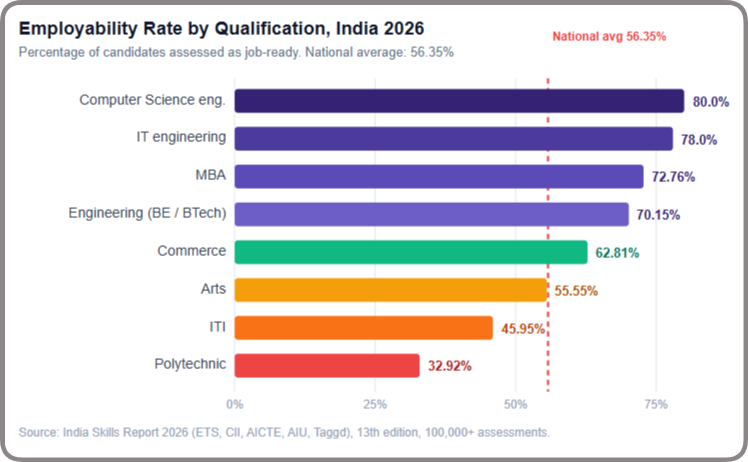
Read the chart correctly. The commerce number going up is good news for a franchisee, not bad. Higher employability in a stream means employers are actively hiring from it, which means job-linked certification in that stream has a buyer. The polytechnic and ITI numbers show where the skills gap is widest, but a wide gap with no hiring demand behind it is not a business.
2. Actual Profit Margins by Education Franchise Category
Not all education franchises share the same economics. The single biggest determinant of your margin is your fixed cost base, and fixed cost is a function of two things: how much square footage the format requires, and how expensive your faculty is.
| Franchise Category | Typical Investment | Net Margin (stabilised) | Primary Margin Killer |
|---|---|---|---|
| Preschool | Rs. 25 to 60 lakh | 15% to 22% | Real estate (1,500 to 3,000 sq ft minimum) plus safety compliance |
| K-12 tutoring | Rs. 10 to 30 lakh | 15% to 25% | Fee compression from free online content |
| Test prep (JEE, NEET, UPSC) | Rs. 20 to 80 lakh | 20% to 30% | Star faculty salaries and seasonal demand |
| Robotics and STEM | Rs. 8 to 25 lakh | 18% to 28% | Long B2B school sales cycle, payment delays |
| Language and personality | Rs. 5 to 15 lakh | 15% to 25% | Near-zero entry barrier means no pricing power |
| Vocational and professional skills | Rs. 15 to 25 lakh | 20% to 40% | Counsellor quality. This is a sales-led model, not a teaching-led one |
Ranges compiled from franchise consulting disclosures, operator interviews and published category reports including Franchise India and FranchiseBazar 2026 outlook data. Treat these as industry-typical bands, not guarantees. Verify against any specific franchisor’s disclosed numbers.
Why vocational sits at the top. Three structural reasons: the format runs on 800 to 1,500 sq ft rather than 3,000; faculty are trainable practitioners rather than star teachers commanding a premium; and course fees of Rs. 15,000 to Rs. 80,000 clear the fixed cost base with a modest batch size. A preschool needs 60 children to work. A skills centre can work on 25 to 40 active learners.
3. Break-Even Timelines Compared
Margin tells you what the business looks like when it works. Break-even tells you how long you fund it before that happens. For most Indian investors, break-even is the more important number, because it determines how much working capital you need to survive.
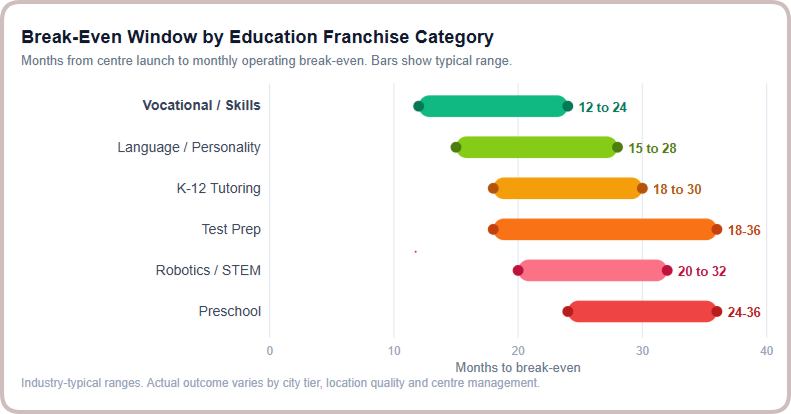
The rule of thumb worth remembering: anything with a stated break-even beyond 30 months should be treated as a red flag, not an opportunity. Either the unit economics are weak, or the franchisor’s support is thin, or both.
4. Why Two Franchisees of the Same Brand Get Completely Different Results
This is the section most franchise content skips, and it is the one that matters most.
Franchisors publish averages. Averages hide the spread. Within any mature education franchise network, centre performance forms a wide distribution: a top group that outperforms the brochure comfortably, a large middle that lands roughly where projected, and a bottom group that never clears break-even and eventually exits.
The variance between them is not brand. It is the same brand. The variance comes from operator behaviour.
| Operating Variable | Underperforming Centre | Top-Performing Centre | Revenue Impact |
|---|---|---|---|
| Lead-to-walk-in rate | Calls leads once, no follow-up | 5 to 7 touchpoints across call, WhatsApp, SMS | 2x to 3x difference |
| Counsellor conversion | Receptionist doubling as counsellor | Dedicated trained counsellor with scripts | Single largest lever |
| Batch fill rate | Starts batches at 40% capacity | Holds until 75%+, runs waitlist | Directly hits gross margin |
| Fee collection discipline | Informal instalments, high leakage | Structured EMI, tracked receivables | 10% to 20% of billed revenue |
| Referral and repeat enrolment | No alumni contact after course ends | Cross-sells second course, tracks placements | Lowest cost revenue you will ever get |
| Owner presence | Treats it as passive investment | On floor 4+ days a week in year one | Correlates with almost everything above |
The single most useful question to ask any franchisor
Do not ask for the average. Ask: “What is the median revenue of centres that opened 24 to 36 months ago, and how many of those centres have since closed?” The median plus the closure rate tells you what a typical investor actually experienced. A franchisor who cannot or will not answer this has told you something important.
5. Why Education Franchises Fail (The Part Nobody Publishes)
Failure in this category is rarely dramatic. It is a slow squeeze. Here are the five patterns that account for most of it.
Failure Mode 1: Undercapitalised launch
The investor budgets the setup cost and forgets the runway. Months 1 to 6 generate a fraction of steady-state revenue while rent, salaries and royalty run at full rate. The centre is not unprofitable; it is simply not yet ramped. But without reserves, the owner starts cutting the marketing and staff that would have driven the ramp. Plan for 9 months of fixed costs in reserve, separate from setup capital.
Failure Mode 2: The wrong 200 metres
Education centres run on visibility and accessibility. A first-floor unit on a main road near a college cluster and a ground-floor unit in a back lane 800 metres away are not comparable businesses, even at identical rent. Walk-ins are the cheapest enrolment you will ever get, and walk-ins are a function of frontage.
Failure Mode 3: Hiring a teacher to do a salesperson’s job
A vocational training centre is a sales business with a classroom attached. Most first-time franchisees hire faculty first and counsellors as an afterthought. The reverse is correct. Faculty can be trained by the franchisor. A counsellor who cannot handle the “what if I do not get a job” objection will cap your enrolment permanently.
Failure Mode 4: Royalty stack shock
The headline royalty is rarely the full number. Add software licence fees, examination fees, courseware charges, mandatory marketing contribution and material markups, and the effective revenue share can land well above the advertised figure. Get every recurring line item in writing before signing and total them yourself.
Failure Mode 5: A course catalogue disconnected from local hiring
A curriculum that sells in Pune may not sell in Muzaffarpur. Before you commit, list the top 20 employers within 30 km of your proposed location and check what roles they actually recruit for. If accounting, compliance, banking operations and data roles dominate, a finance and accounts skills franchise has a market. If they do not, no amount of brand equity fixes that.
6. The 7-Point Profitability Checklist Before You Sign
Pass all seven and the brand is worth a serious conversation. Fail two or more and no projected margin justifies the risk.
| # | What to Verify | Healthy Signal | Walk Away If |
|---|---|---|---|
| 1 | Median break-even across recent cohort | 12 to 24 months | Beyond 30 months, or “we do not track that” |
| 2 | Total effective revenue share | 10% to 15% all-in | Above 20% once every line item is added |
| 3 | Franchisor-generated lead volume per centre per month | A specific number, in writing, for a comparable city | “We have a strong national digital presence” |
| 4 | Network age profile | 50+ centres running 3 years or more | Network is mostly openings from the last 18 months |
| 5 | Franchisee churn and closure count | Disclosed openly, median tenure 5+ years | Deflection, or “nobody has ever closed” |
| 6 | Access to franchisees you select yourself | Full network list, you pick who to call | Only three curated references offered |
| 7 | Territory protection clause | Defined radius or pincode exclusivity in the agreement | Verbal assurance only |
7. Where ICA Edu Skills Fits in This Picture
Apply the framework above to ICA Edu Skills, because a franchisor that publishes a checklist should be willing to be measured against it.
ICA Edu Skills at a glance
| Operating since | 1999. Over 27 years across the 2008 crisis, demonetisation, GST rollout and COVID |
| Network | 100+ centres pan-India, with depth in Tier 2 and Tier 3 Eastern, Northern and Central India |
| Learners trained | 6 lakh+ verified alumni |
| Employer network | 70,000+ registered employers, 30 dedicated placement offices |
| Category | Vocational and professional skills: accounting, GST, Tally, SAP FICO, banking, advanced Excel, data analytics |
| Placement commitment | 100% Job Guarantee on flagship job-linked courses (CIA and CIA Plus), subject to course completion and defined eligibility criteria. Placement assistance across other programmes, subject to eligibility |
Why this matters to your margin specifically. Go back to the variance table in Section 4. The single largest lever was counsellor conversion, and the hardest objection a counsellor faces is “what happens if I do not get a job.” When the answer to that is a written commitment backed by a 70,000-employer network rather than a vague assurance, the conversation changes. That is not a marketing point; it is a direct input into the one variable that decides whether your centre lands in the top band or the bottom.
Second lever: lead supply. Checklist item 3 asks whether the franchisor generates leads or leaves you to run your own Google and Meta campaigns. ICA runs national digital campaigns and routes enquiries to the nearest centre by pincode. A franchisee should not have to become a performance marketer to make a centre work.
What ICA does not claim. No salary figures. No guaranteed monthly income. No promise that a centre in any location will succeed. Job guarantee applies to specific flagship courses under stated eligibility conditions, and it is a placement commitment, not a compensation commitment. Any franchisor promising you a specific rupee return is telling you something that cannot be true across a network.
Frequently Asked Questions
Are education franchises profitable in India in 2026?
Yes, in the sense that the category supports healthy unit economics. Vocational and professional skills training franchises typically operate at 20% to 40% net margin once enrolment stabilises, with break-even in 12 to 24 months. Preschool and test-prep formats deliver lower margins (15% to 30%) over longer break-even windows (24 to 36 months). Profitability at any individual centre depends more on location quality, counsellor conversion and owner involvement than on category averages.
Which education franchise category has the highest profit margin?
Vocational and professional skills training has the highest typical net margin in India at 20% to 40%. It combines a lean footprint of 800 to 1,500 sq ft, trainable rather than premium-priced faculty, and course fees of Rs. 15,000 to Rs. 80,000 that clear fixed costs at modest batch sizes. Preschool franchises, by contrast, carry real estate and compliance costs that compress margins to roughly 15% to 22%.
How long does an education franchise take to break even?
A healthy education franchise breaks even between 12 and 24 months. Vocational skills centres in demand-dense locations sit at the shorter end. Preschool and test-prep formats typically need 24 to 36 months due to higher real estate and faculty costs. A stated break-even beyond 30 months should be treated as a warning sign about either unit economics or franchisor support.
Why do education franchises fail in India?
Five recurring causes: undercapitalised launch with no working capital runway for the 6 to 9 month ramp; poor location with low visibility and footfall; hiring faculty before hiring a trained counsellor, when the model is sales-led; underestimating the total royalty stack once software, exam, courseware and marketing charges are added; and a course catalogue misaligned with what employers within 30 km actually hire for.
Is an education franchise recession-resistant?
Relatively, but not immune. Job-linked skills training tends to hold up better than discretionary categories because enrolment often rises during weak hiring markets, when candidates upskill to compete. Test prep and preschool are more exposed to household discretionary spending. No education format is genuinely recession-proof; vocational training is simply less cyclical than most.
Do I need an education background to run an education franchise profitably?
No. The best-performing centres are typically run by operators with sales and local network strengths rather than academic credentials. Curriculum, faculty training and content are supplied by the franchisor. What you need is capital adequacy, a strong local network, discipline around counselling and fee collection, and willingness to be physically present at the centre through year one.
What is a reasonable royalty for an education franchise in India?
Ten to fifteen percent of revenue, or a fixed monthly fee in that band, is the healthy range. The important number is the effective total once software licences, examination fees, courseware charges and mandatory marketing contributions are included. If that total exceeds 20% of revenue, margins compress sharply. Always request every recurring line item in writing before signing.
Important disclaimer. All margin, break-even and investment figures in this article are industry-typical ranges drawn from published category research and operator interviews. They are provided for general information and are not projections, forecasts, guarantees or earnings representations for any specific franchise opportunity, including ICA Edu Skills. Actual results vary substantially by location, market conditions, capital adequacy and operator execution. Prospective investors should conduct independent due diligence and consult a qualified financial or legal adviser before committing capital.
- What support does ICA Edu Skills provide to franchise partners?
- Which education franchise under 50 lakhs is best
- How to choose a most profitable education franchise in India?
- Which Education Franchise Is Most Profitable in India?
- How Much Investment is Needed to Open an Education Franchise in India?
- Is ICA Edu Skills a franchise?
- ICA Edu Skills Franchise Reviews – Partner Stories

LinkedIn: https://www.linkedin.com/in/sankar-chakraborty-38406844/
- Top Education Business Ideas in India for Serious Entrepreneurs - October 13, 2026
- Best Franchise Business in India: A Proven, Honest Guide - September 29, 2026
- Education Franchise Tax Benefits – A comprehensive Insight - September 24, 2026