
Which Education Franchise Is Most Profitable in India? (2026 Investor Guide)
Quick Answer: Which education franchise is most profitable in India?
In 2026, the most profitable education franchise category in India is vocational and professional skills training — driven by faster break-even (12–24 months), lower setup investment (Rs. 8–25 lakh), and structural demand backed by government policy (Skill India, NSDC, NEP 2020). Within this category, ICA Edu Skills is one of the most-evaluated franchise opportunities, with 27+ years of operations, 100+ centers, 100% Job Guarantee on flagship courses, and a network of 70,000+ registered employers. Scroll down for category-by-category data, ROI benchmarks, and how to evaluate any opportunity.
If you’re an investor asking “which education franchise is most profitable?”, you’re starting in the right place — but most investors ask the question the wrong way. The most profitable education franchise in India isn’t a single brand name. It’s the intersection of a structurally growing category, a franchisor with operational depth across a full business cycle, and unit economics that survive a city-by-city stress test.
This guide gives you the data to think about education franchise profitability correctly. We’ll cover the macro market opportunity, compare ROI and break-even across the six main education franchise categories in India, and explain why ICA Edu Skills has become one of the most-evaluated franchise opportunities in the professional skills training segment.
Which Education Franchise Is Most Profitable in 2026?
Before any discussion of which education franchise is most profitable, ground yourself in the macro reality of the Indian education and skill development market.
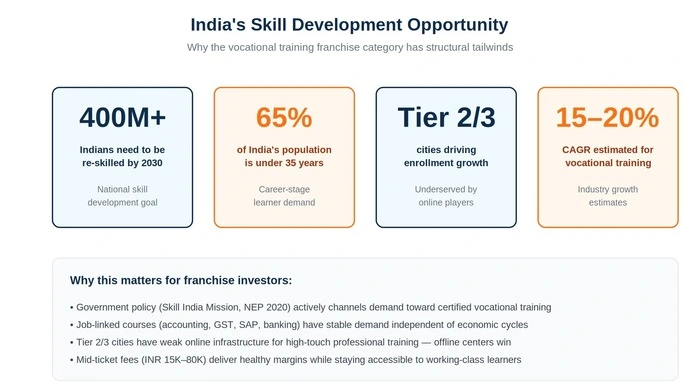
Source: National Skill Development Corporation (NSDC), Skill India Mission targets, industry research reports.
India has the world’s largest youth population and one of its largest education markets. These numbers matter because they determine demand durability — the single biggest factor in any education franchise’s profitability:
- 400 million+ Indians need to be skilled or re-skilled by 2030, per the National Skill Development Corporation (NSDC) and Skill India Mission targets. This isn’t a wish-list number — it’s tied to government-funded programs and corporate hiring requirements.
- 65% of India’s population is under 35. That’s the active learner base. Career-stage workers in their 20s and 30s drive the bulk of professional training and vocational franchise demand.
- Tier 2 and Tier 3 cities are growing faster than metros for offline professional training, because online players struggle to deliver high-touch certification training there. This is where the education franchise model has the strongest moat.
- Industry estimates put vocational training CAGR at 15–20%, materially higher than mature segments like K–12 tutoring or preschool franchises.
The implication: not every education franchise category is riding this wave. Some — preschool, K–12 tutoring — are seeing margin compression from competition and online disruption. The vocational and professional skills segment, by contrast, has tailwinds the others don’t, which is why it consistently emerges as the most profitable education franchise category in India.
How to Identify the Most Profitable Education Franchise: 7 Investor Benchmarks
Before naming any brand, here are the metrics that separate a profitable education franchise from a money-pit. Hold every opportunity up against these — including ours.
| Metric | Healthy Benchmark | Red Flag |
|---|---|---|
| Break-even period | 12–24 months | 30+ months |
| Royalty / revenue share | 10–15% | 20%+ |
| Total franchise fee (excl. setup) | 8–15% of first-year revenue | 25%+ |
| Lead supply from franchisor | National campaigns + pincode routing | “You handle your own marketing” |
| Median ROI (Year 2) | 25–40% | Below 15% or unverifiable |
| Network size with 3+ years operating | 50+ mature centers | Mostly recent openings |
| Median franchisee tenure | 5+ years | High churn |
A note on benchmarks: these are industry-typical ranges. The most important number isn’t the franchisor’s best center — it’s the median franchisee outcome across the network. When evaluating which education franchise is most profitable for your situation, always ask for the median, not the average.
A franchisor who answers all these questions transparently is one worth talking to. One who deflects is one to avoid.
Which Education Franchise Category Is Most Profitable? Comparing the Six Segments
The Indian education franchise market splits into six main categories. Their profitability profiles are not equal. Here’s the comparative view of which education franchise categories offer the strongest ROI in India:
| Category | Typical Investment | Break-Even | Outlook |
|---|---|---|---|
| Preschool | Rs. 25–60 lakh | 24–36 months | Stable but capital-heavy |
| K–12 Tutoring | Rs. 10–30 lakh | 18–30 months | Margin compression |
| Test Prep (JEE/NEET/UPSC) | Rs. 20–80 lakh | 18–36 months | Cyclical, online-disrupted |
| Robotics / STEM | Rs. 8–25 lakh | 20–32 months | B2B-dependent, slow cycle |
| Language / Personality | Rs. 5–15 lakh | 15–28 months | Low pricing power |
| Vocational / Professional Skills | Rs. 8–25 lakh | 12–24 months | Strongest tailwinds |
Ranges are typical industry observations from franchise consulting reports, franchisor disclosures, and operator interviews. Verify against franchisor-specific data before investing.
Based on the comparison above, the most profitable education franchise category in India is vocational and professional skills training — combining the lowest break-even window (12–24 months), accessible investment (Rs. 8–25 lakh), and structural demand tailwinds. Let’s walk through what the data tells us about each category.
Preschool franchises
Strong brand value, but capital-intensive: real estate (1,500–3,000 sq ft minimum), staff costs, and a hard ceiling on per-child revenue. Margins are decent, but you’re paying for premium real estate and compliance.
K–12 tutoring and coaching
Brutal competition from online players and free YouTube content. Average ticket sizes have compressed over the last four years. Even strong brands are seeing falling enrollments per center.
Test prep franchises (JEE, NEET, UPSC, CAT)
Lucrative in tier-1 cities with star faculty, but high faculty cost and cyclical demand tied to exam patterns. Online disruption from BYJU’S, Unacademy, PhysicsWallah has reshaped this market — and not in the franchisee’s favor.
Robotics and STEM franchises
Growing category but depend heavily on school B2B partnerships, which are slow to close, price-sensitive, and seasonal. Sales cycle is long and unpredictable.
Language and personality development
Low entry barriers mean low pricing power. The category is crowded, and most centers struggle to differentiate on anything besides location.
Professional skills and vocational training — the most profitable education franchise category
This is the category ICA Edu Skills operates in, and it consistently emerges as the most profitable education franchise segment in India. Here’s why it structurally outperforms:
- Courses (accounting, GST, Tally, SAP, banking, data analytics, payroll) are tied to actual job functions employers hire for, in every economic cycle.
- Enrollment correlates with the broader workforce, not a niche exam or school calendar.
- Course fees of Rs. 15,000–80,000 are high enough for healthy unit economics, accessible enough for volume.
- Learners often take 2–4 courses over 12–18 months, raising lifetime value per enrollment.
- Government policy actively supports this category — Skill India, NSDC partnerships, NEP 2020 vocational push.
This is the structural reason this category wins the “most profitable education franchise” question. It’s not about any one brand being clever. It’s that the underlying demand is broader, deeper, and less cyclical than any other education franchise category.
Why ICA Edu Skills Ranks Among the Most Profitable Education Franchise Opportunities in India
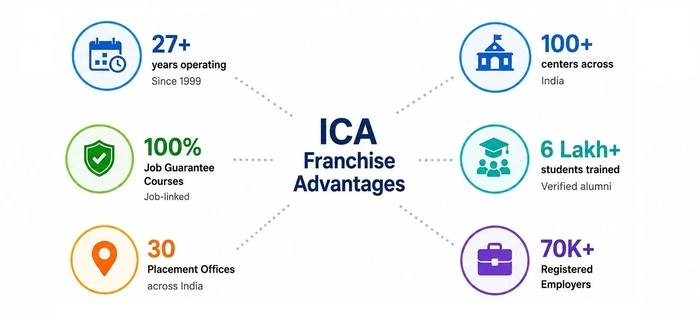
1. 27+ years operating across a full business cycle (since 1999)
ICA has operated through the 2008 global financial crisis, demonetisation, the GST rollout (which actually expanded demand for our flagship Industrial Accountant course), COVID, and the post-COVID hiring shifts. A franchisor that has survived four macroeconomic shocks has a playbook for the fifth. This is rare in the Indian education franchise market — most operators in the vocational space are under 10 years old, which is why ICA features prominently when investors research the most profitable education franchise in India.
2. 100+ centers, with deep penetration in tier-2 and tier-3 India
ICA is not the most-marketed brand in metro India — we don’t try to be. Where we’re strong is the tier-2 and tier-3 belt across Eastern, Northern, and Central India: Kolkata, Patna, Jamshedpur, Bhubaneswar, Ranchi, Lucknow, Guwahati, Bhopal, Raipur, and dozens of similar cities. In these markets, ICA brand recognition translates directly into walk-ins — and walk-ins are the lowest-cost lead a center will ever get.
3. 100% Job Guarantee on flagship job-linked courses
This is a meaningful differentiator. Most education franchises offer vague “placement assistance” that varies in execution. ICA’s flagship job-linked courses come with a 100% Job Guarantee — a written commitment that learners who complete the course and meet defined performance criteria will be placed.
To be precise: this is a job guarantee, not a salary guarantee. We don’t promise specific compensation figures, and you should be suspicious of any institute that does. But a guaranteed placement commitment, backed by a 70K+ employer network and 30 placement offices, is real conversion fuel for a franchise counsellor. When a walk-in asks “what if I don’t get a job?”, the answer is contractual, not aspirational. That changes the close rate — and the close rate is what makes any education franchise profitable.
4. 6 Lakh+ verified alumni driving organic enrollment
This number compounds. Hiring demand drives placement, placements drive word-of-mouth, word-of-mouth drives next year’s enrollment. The cheapest lead a franchise will ever get is a referral from a placed alumnus — and after 27 years, the referral economy in ICA’s strong cities runs on its own. For a new franchisee opening in an ICA-strong city, you’re inheriting that referral base from day one.
5. 30 Placement Offices across India
Placement isn’t a side function at ICA — it’s an infrastructure investment. We operate 30 dedicated placement offices across India whose entire mandate is matching learners with employers. Most education franchises don’t have this. Most franchise centers handle placement informally, on the side, when the main course schedule allows. ICA franchisees plug into a centralised placement engine. For your center, this means course completion converts into actual job offers — which converts into the next cohort’s enrollment.
6. 70K+ Registered Employers
The employer network is the engine behind the job guarantee. Audit firms, banks, NBFCs, BPOs, corporate accounting departments, regional CA firms, MSMEs — 70,000+ active employers across India have hired from ICA. For a franchise investor, this matters in two ways: it’s the substantive backing for the placement promise, and it’s a moat — building this many employer relationships from scratch takes decades, not quarters.
Beyond the headline numbers: what franchisees actually get
The six data points above explain ICA’s category position. Here’s what they translate into operationally for a franchisee evaluating which education franchise is most profitable for their city:
Central lead generation that actually feeds your center. This is where most education franchises quietly fail — the franchisor sells you a center, then leaves you to figure out Google Ads, Meta Ads, and SEO on your own. A franchisee shouldn’t have to learn performance marketing to make their center work. ICA runs national digital campaigns across Google, Meta, and YouTube, generates leads, and routes them to the nearest center by pincode.
Curriculum aligned to actual hiring demand. Our flagship courses are built around what employers pay for:
- CIA (Certified Industrial Accountant) — comprehensive accounting + Tally + GST + SAP exposure
- CBP (Certified Banking Professional) — banking ops, financial products, retail banking
- GST Practitioner courses — directly linked to a national compliance requirement
- SAP FICO, Tally Prime, Advanced Excel, Data Analytics — software skills that command salary premiums
- Multi-month diploma programs — higher ticket sizes, deeper learner commitment
Operational support that doesn’t end at signing. Faculty training, course content updates, software licenses, counselling scripts, marketing collateral, audit and review cadence — the franchisor’s job begins, not ends, at the agreement.
What an ICA Franchise Center Looks Like, in Numbers
Here’s the operational shape of a typical ICA education franchise center (varies by city tier and format):
| Parameter | Typical Range |
|---|---|
| Setup investment | Mid-range for the category (shared on discovery call) |
| Space required | 800–1,500 sq ft |
| Staff at launch | 1 center manager + 2–4 faculty + 1 counsellor |
| Course fee per student | Rs. 15,000 – Rs. 80,000 |
| Batches per quarter | 4–8 (varies by city demand) |
| Royalty structure | Standard category range (transparent, in writing) |
| Lead source | Centrally routed by pincode + local walk-ins |
| Target break-even | 12–18 months in active demand cities |
We deliberately don’t put exact rupee figures in marketing collateral because they vary by city. The discovery call gives you city-specific numbers — and we share them in writing, not just verbally.
Want the actual numbers for your city? Fill out the franchise query form and our team will share the full investment breakdown, projected lead volume, and median break-even data for your target location within 48 hours.
What Honest Risk Looks Like in an Education Franchise Investment
If a franchisor doesn’t tell you the risks, walk away. Here are the real ones — for any education franchise, including ours.
Risk #1: Center execution, not brand choice, is the single biggest factor. A weak center manager in a strong city will lose money. A strong center manager in a weaker city will still make money. The franchisor can hand you brand, leads, curriculum, and training — but the daily work of running counselling, managing faculty, following up with enrolled students, and converting walk-ins is yours. Most failed education franchises fail here, not at the franchisor level.
Risk #2: Location. Education franchises live and die on footfall and accessibility. A center in a back lane with poor signage will underperform a center on the main road, even with identical brands. ICA’s franchise team conducts a market study before approving any location — but the final responsibility is yours.
Risk #3: Local competition. Even strong brands can struggle in a market saturated with three other established institutes. Honest franchisors do a market study before approving your city. The ones who approve any city for anyone are usually optimising for franchise fee collection, not your success.
Risk #4: Capital readiness. Don’t open a franchise on borrowed working capital. The first 6 months will have lower-than-projected revenue while the center builds local credibility. Plan for 9 months of fixed costs in reserve.
We say all this because investors who go in eyes-open succeed. Investors who go in expecting magic don’t.
How to Evaluate Any Education Franchise Opportunity in 5 Steps
Before signing any education franchise agreement, do these five things:
- Ask for median break-even across all centers opened in the last three years — not the average, not the success story. Median tells you the truth about a typical investor’s experience.
- Speak to three current franchisees you pick yourself from the network list. Don’t let the franchisor route you to their happiest investors only.
- Request lead volume data for your target city or a comparable one. Marketing claims like “national digital presence” are meaningless without lead volume per center per month.
- Walk into two existing centers unannounced, if you can. Look at classroom quality, student count, and how the counsellor treats walk-ins. This tells you more than any sales presentation ever will.
- Get the royalty and recurring cost structure in writing with every line item — software fees, exam fees, material costs, marketing contributions. Add them up. That’s your real revenue share, not the headline royalty number.
A franchisor who passes all five is one worth investing with. A franchisor who passes four out of five with a credible explanation is still worth a serious conversation. A franchisor who fails two or more — walk.
Frequently Asked Questions: Which Education Franchise Is Most Profitable?
Which education franchise is most profitable in India in 2026?
The most profitable education franchise category in India in 2026 is vocational and professional skills training. It offers the fastest break-even (12–24 months), lower setup investment (Rs. 8–25 lakh), and is backed by structural demand from government initiatives like Skill India and NSDC. Within this category, ICA Edu Skills is one of the most-evaluated franchise opportunities, with 27+ years of operations, 100+ centers, and a 100% Job Guarantee on flagship courses.
How much does it cost to start an education franchise in India?
Education franchise investment in India typically ranges from Rs. 5 lakh to Rs. 80 lakh, depending on category. Language and personality development franchises start at Rs. 5–15 lakh; vocational and professional skills training franchises (the most profitable category) require Rs. 8–25 lakh; preschool franchises need Rs. 25–60 lakh; and large test-prep franchises can require Rs. 20–80 lakh. ICA Edu Skills franchise investment falls in the mid-range of the vocational category.
What is the typical ROI of an education franchise in India?
A well-structured education franchise in India should deliver a median Year-2 ROI of 25–40% and break even between 12 and 24 months. Anything beyond 30 months for break-even is a red flag — either the unit economics are weak or the franchisor’s support is thin. ROI varies significantly by category: vocational training tends to outperform preschool and K–12 tutoring on both speed of payback and ongoing margins.
Is a vocational training franchise more profitable than a preschool or coaching franchise?
Yes — in most cases. Vocational training franchises generally outperform preschool and K–12 coaching franchises on three measures: faster break-even (12–24 months vs. 24–36 months for preschool), lower setup investment (Rs. 8–25 lakh vs. Rs. 25–60 lakh for preschool), and stronger demand durability because courses are tied to job functions rather than school calendars or exam cycles disrupted by online players.
How long does it take an education franchise to break even?
A healthy education franchise should break even between 12 and 24 months. Vocational and professional skills training franchises in tier-2 and tier-3 Indian cities typically achieve break-even closest to the 12-month end. Preschool and test-prep franchises tend to take 24–36 months because of higher real estate, faculty, and capital requirements.
What makes ICA Edu Skills different from other education franchises in India?
ICA Edu Skills differs from most education franchises on six measurable points: 27+ years of operations since 1999, 100+ centers, 100% Job Guarantee on flagship job-linked courses, 6 Lakh+ verified alumni, 30 dedicated placement offices, and a network of 70,000+ registered employers. The job guarantee specifically — a written placement commitment, not a salary promise — is rare in the Indian education franchise market and is a significant counselling and enrollment advantage for franchisees.
Which is the best education franchise for tier-2 and tier-3 cities in India?
For tier-2 and tier-3 Indian cities, vocational training franchises generally outperform metro-focused brands because online players cannot deliver high-touch certification training in these markets, and demand for job-linked accounting, banking, and skill courses is structurally underserved. ICA Edu Skills has deep penetration in this belt — Kolkata, Patna, Jamshedpur, Bhubaneswar, Ranchi, Lucknow, Guwahati, Bhopal, Raipur — which translates into existing brand recognition for new franchisees.
What is the royalty fee for an education franchise in India?
A reasonable education franchise royalty in India is 10–15% of revenue, or a fixed monthly fee in that range. Royalty structures above 20% — especially when combined with mandatory marketing contributions and material markups — erode franchisee margins significantly. Always get the full recurring cost structure in writing with every line item before signing.
The Honest Conclusion: Which Education Franchise Is Most Profitable?
The most profitable education franchise in India is not a single brand — it’s the intersection of:
- A structurally growing category (vocational and professional skills training is currently the strongest in India)
- A franchisor with full-cycle operational depth (10+ years minimum, ideally 20+)
- A location with real demand (tier-2 and tier-3 India has the widest profitability gap)
- An investor willing to run the center like a real business (not a passive asset)
In the professional skills training category, ICA Edu Skills has built 27+ years of category leadership, 100+ centers across India, 100% Job Guarantee on flagship courses, 30 dedicated placement offices, and a verified network of 70,000+ registered employers. That doesn’t mean it’s the right franchise for every investor. It means it’s worth a real conversation if you’re seriously evaluating which education franchise is most profitable for your city and capital.
If you want the actual numbers — investment range for your city, projected break-even, current lead volume in your pincode, the contractual royalty structure, and the names of current franchisees you can call — fill out the franchise query form below. You’ll get a structured discovery call with our franchise team, not a sales pitch.
Ready to evaluate the ICA franchise opportunity?
- What support does ICA Edu Skills provide to franchise partners?
- Which education franchise under 50 lakhs is best
- How to choose a most profitable education franchise in India?
- How Much Investment is Needed to Open an Education Franchise in India?
- Is ICA Edu Skills a franchise?
- ICA Edu Skills Franchise Reviews – Partner Stories
Tags: Education Franchise | Franchise India | Vocational Training | ICA Edu Skills | Skill Development | Business Investment

LinkedIn: https://www.linkedin.com/in/sankar-chakraborty-38406844/
- Best Franchise Business in India: A Proven, Honest Guide - September 29, 2026
- Education Franchise Tax Benefits – A comprehensive Insight - September 24, 2026
- Skill Development Franchise for Placement: What the Data Really Says - August 28, 2026