
Education Franchise Business in India: The Investor’s Handbook (2025–26)
Most investors researching an education franchise business in India ask the wrong first question. They jump straight to “Which brand should I pick?” — before checking whether the segment they are entering has viable unit economics at their budget. That sequencing error causes more failed centre launches than any other factor. This guide works in the opposite direction: market reality first, brand selection second.
Quick Summary: India’s education sector is valued at over $100 billion and growing at 9.79% CAGR. An education franchise offers multiple entry points — from ₹5 lakh (vocational skills) to ₹1 crore+ (K-12 schools). For first-time investors, vocational accounting and finance training franchises offer the best risk-adjusted returns: lowest capex, 12–24 month break-even, and maximum whitespace in tier-2 and tier-3 towns.
Why the Education Franchise Business in India Market Demands Attention Right Now
The scale is no longer speculative. India’s school market alone reached USD 59.67 billion in 2025 and is projected to reach USD 138.33 billion by 2034 (CAGR: 9.79%), according to IMARC Group. The broader Indian education sector is independently valued at approximately USD 100 billion, growing across every sub-segment simultaneously.
Three converging forces explain the momentum:
- Demographic scale: 26.31% of India’s population is aged 0–14. Over 250 million students are enrolled in Indian schools.
- Policy push: NEP 2020 mandates vocational integration from Class 6. The Skill India Mission is actively funding skills training infrastructure.
- Supply-quality gap: Most tier-2 and tier-3 towns still lack accredited, brand-backed professional training centres — which is exactly where franchise whitespace exists.
India Education Market — Segment Size and Growth Rate
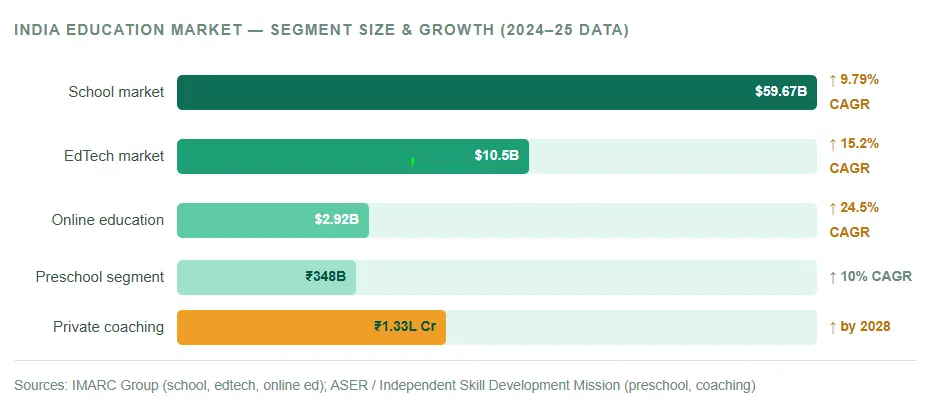
“India is the second-largest e-learning market in the world after the US. The private coaching industry alone is projected to reach ₹1.33 lakh crore by 2028, with GST collections from coaching institutions rising 150% between 2020 and 2024.” — ExamCharcha Education Franchise Analysis, 2026
The Five Main Segments of Education Franchise Business in India
Not all education franchises in India carry the same risk or return profile. Here is a structured breakdown of every major category with honest investment and ROI benchmarks for each.
| Vocational Skills & Accounting / Finance Training ⭐ | ||||||
| What It Covers | Investment Range | Expected ROI | Break-even | Capex Risk | Best Geography | Ideal For |
|---|---|---|---|---|---|---|
| Accounting, Tally, GST, SAP FICO, Data Analytics, Payroll, MIS — job-oriented courses for working professionals and fresh graduates | ₹5 – 20 lakh | 40% – 70% | 12 – 24 months | Low | Tier-2 & Tier-3 towns (maximum whitespace) | First-time investors with limited capital seeking fast break-even |
| What It Covers | Investment Range | Expected ROI | Break-even | Capex Risk | Best Geography | Ideal For |
| Pre-school & Childcare Franchise | ||||||
| Early childhood education centres, play schools, daycare — brands like Kidzee, EuroKids, KLAY | ₹20 – 50 lakh | 25% – 35% | 2 – 3 years | Medium | Tier-2 towns (metro markets are saturated) | Investors with moderate capital and a long-term neighbourhood brand vision |
| What It Covers | Investment Range | Expected ROI | Break-even | Capex Risk | Best Geography | Ideal For |
| K-12 School Franchise | ||||||
| CBSE / CISCE affiliated private schools — brands like DPS, Orchids, Seth Anandram Jaipuria | ₹1 crore+ | 15% – 25% | 4 – 6 years | High | Tier-1 & Tier-2 cities | Well-capitalised investors with real estate assets and a 5-year horizon |
| What It Covers | Investment Range | Expected ROI | Break-even | Capex Risk | Best Geography | Ideal For |
| Test Preparation & Coaching Franchise | ||||||
| JEE, NEET, CLAT, banking and government exam coaching — brands like Aakash, FIITJEE, TIME, Career Launcher | ₹30 – 75 lakh | 30% – 50% | 2 – 3 years | Medium | All tiers — strongest in Tier-1 and Tier-2 | Investors who can verify the brand’s audited exam success-rate data before signing |
| What It Covers | Investment Range | Expected ROI | Break-even | Capex Risk | Best Geography | Ideal For |
| Overseas Education & Study-Abroad Counselling | ||||||
| University admission consulting, visa counselling, IELTS/TOEFL prep — brands like KC Overseas, Edumilestones | ₹75,000 – 10 lakh | 50% – 80% | 12 – 18 months | Very Low | Tier-1 & Tier-2 cities (low demand in Tier-3) | Service-oriented investors with strong counselling capability and university tie-ups |
⭐ Top pick for first-time investors: Vocational skills and accounting/finance training franchises consistently offer the best risk-adjusted entry into the education business in Indian market — lowest capex, fastest break-even, policy tailwind from Skill India, and significant whitespace in tier-2 and tier-3 towns where established branded training centres are still scarce.
Education Franchise Business in India: Full ROI Comparison Table
Use this table as your first financial filter — not the franchisor’s brochure. All figures are indicative benchmarks. Actual performance depends on location tier, brand strength, and operator quality.
| Segment | Investment Range | Break-even | Projected ROI | Capex Risk | Best Geography |
|---|---|---|---|---|---|
| Vocational Skills / Accounting & Finance ⭐ Top Pick | ₹5–20 lakh | 12–24 months | 40–70% | Low | Tier-2 & Tier-3 |
| Pre-school / Childcare | ₹20–50 lakh | 2–3 years | 25–35% | Medium | Tier-2 Towns |
| Test Prep / Coaching | ₹30–75 lakh | 2–3 years | 30–50% | Medium | All tiers |
| Study Abroad Counselling | ₹75K–10 lakh | 12–18 months | 50–80% | Very Low | Tier-1 & Tier-2 |
| K-12 School | ₹1 crore+ | 4–6 years | 15–25% | High | Tier-1 & Tier-2 |
| EdTech / Hybrid Online | ₹5–25 lakh | 18–30 months | Variable | Medium | Pan-India |
⚠️ The number to model — not the brochure number: Most franchisors quote ROI at their national average fee level. Always model your unit economics at your specific city’s prevailing fee ceiling. In tier-2 towns, this is typically 30–40% lower than a metro average. If the numbers still work at that discounted fee, the franchise is worth pursuing.
N.B.: ROI figures cited in this article are indicative benchmarks drawn from publicly available industry data. Actual returns depend on location, market conditions, brand performance, and operator quality. Placement support specifics are program-dependent. Conduct independent due diligence before making any franchise investment decision.
Where Education Franchise Opportunity Is Highest in India: Geography Matrix
Franchise whitespace in India is a tier-based story. The cities with the most growth potential for an education franchise business are not the metros — it is the 300+ tier-2 and tier-3 towns where quality branded training is still absent.
| Segment | Metro Cities | Tier-2 Towns | Tier-3 Towns |
|---|---|---|---|
| Vocational / Accounting | Competitive | ✅ Strong | ✅✅ Very Strong |
| Pre-school | ❌ Saturated | ✅ Good | Emerging |
| Test Prep / Coaching | Competitive | ✅ Strong | Moderate |
| K-12 School | Established | ✅ Good | Emerging |
| Study Abroad | ✅ Strong | ✅ Good | ❌ Low demand |
ICA Edu Skills: India’s Established Vocational Accounting Franchise — A Closer Look
If you are seriously evaluating a vocational skills education franchise business in India, ICA Edu Skills is one name that consistently surfaces for the right reasons — not just the length of its track record, but the specificity of its employer ecosystem.
Founded over 27 years ago, ICA Edu Skills has trained and placed over 6 lakh students across India in accounting, finance, and business skills roles. With 100+ active centres pan-India and 30+ dedicated placement offices, it operates one of the largest vocational franchise networks in the accounting and finance space.
What the ICA Franchise Network Covers
The courses cover every major employability skill in accounting and finance:
- Certified Industrial Accountant (CIA / CIA+) — with structured 100% job guarantee support for eligible graduates
- Tally Prime + GST
- SAP FICO (S/4 HANA) and SAP MM, SD, PP
- Data Analytics (Power BI, Excel, SQL)
- GST Certification, Income Tax, Payroll
- Diploma in Financial Markets (DFM/Stock Market)
- Cambridge English, Advanced Excel, Microsoft Office
The franchise model includes territory rights, a CRM-integrated lead management system, digital marketing support, faculty training, and curriculum updates tied to live regulatory changes — including real-time GST and SAP version updates.
ICA Edu Skills — Key Franchise Data
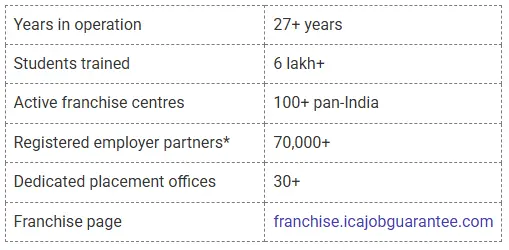
*70,000+ registered employer partners figure carries a standard caveat. Placement support is subject to program type and student eligibility. CIA/CIA+ programs carry a structured 100% job guarantee commitment. Other programs provide placement assistance subject to eligibility.
For investors specifically evaluating the accounting and finance segment of the education business, ICA’s combination of curriculum depth, regulatory currency (GST, SAP S/4 HANA, compliance), and an employer network built over 27 years is difficult to replicate independently.
→ Explore the ICA Edu Skills Franchise Opportunity
Three Red Flags Before Signing Any Education Franchise Agreement in India
The market numbers are compelling. But three risks are systematically underplayed in every franchisor pitch.
Red Flag 1 — Curriculum Decay
Your revenue is capped by the franchisor’s curriculum relevance. A vocational skills brand that has not updated its SAP or GST curriculum in three years will lose students to competitors regardless of how well you run your centre. Before signing, request the curriculum update log for the last two years. If the franchisor cannot produce it, treat that as a disqualifier.
Red Flag 2 — Metro Saturation Presented as “High Demand”
Most established education franchise brands in India have already granted dense coverage in metros. The growth opportunity is in tier-2 and tier-3 towns. Some franchisors do not advertise this clearly — because metro territory fees are higher. Run a competitor audit of the specific locality you are targeting before committing.
Red Flag 3 — Placement Guarantee vs. Placement Support
These are legally and commercially very different. In India’s vocational training space, “placement guarantee” claims require careful scrutiny. A legitimate brand will explicitly differentiate between programs with a structured job commitment and programs where the institute provides placement assistance — outcomes in the latter case are market-dependent and not a guarantee.
Investor Evaluation Checklist: Education Franchise Business in India
Use this checklist before meeting any franchisor. If they cannot answer these with verifiable data, that is your answer.
Brand and Operations
- How many centres are currently operational (not just signed)?
- What is the franchisee exit/attrition rate over the last 3 years?
- What is the average annual revenue per centre in your target city tier?
Curriculum and Quality
- When was the core curriculum last updated? (For GST/SAP: must be within 12 months)
- Are courses NSDC-aligned or NSQF-certified? (Unlocks government-funded enrolments)
- What is the verified employer network count, and can you see recent placement records?
Commercial Terms
- Is royalty structure flat fee, revenue share, or per-student? (Revenue share aligns incentives better for early-stage centres)
- What is the territory exclusivity definition — exact radius or pin-codes?
- What are the minimum enrolment targets, and what are the penalties for missing them in Year 1?
Support Infrastructure
- Is there a CRM or lead management system for franchisees?
- Does the franchisor run national-level digital marketing, or are franchisees on their own?
- What does initial faculty training include, and is there ongoing support?
Policy and Regulatory Environment for Education Franchise Business in India
India’s regulatory environment is broadly favourable for private education investment. Key policy pillars that directly benefit education franchise operators:
- 100% FDI allowed: The Government of India permits 100% Foreign Direct Investment in the education sector, encouraging private and international investment at all levels.
- Govt of India NEP 2020: The National Education Policy mandates vocational education integration from Class 6. This creates long-term, policy-backed demand for certified vocational training providers.
- Skill India / NSDC: Franchises with NSDC alignment and NSQF certification can access government-funded student batches — a dual revenue stream of private fee plus government subsidy.
- Budget allocation: The Union Budget 2021–22 allocated over ₹54,000 crore (USD 7.53 billion) to the Department of School Education and Literacy — signalling sustained public investment in education infrastructure.
For current policy verification, the authoritative source is the Ministry of Skill Development and Entrepreneurship (MSDE) official portal. Any franchisor claiming NSDC empanelment or government scheme participation should be cross-verified directly through this source before investment.
Frequently Asked Questions: Education Franchise Business in India
How much investment is required for an education franchise?
Investment varies by segment. Vocational and skills training franchises require ₹5–20 lakh. Pre-school franchises require ₹20–50 lakh. Test-prep and coaching franchises require ₹30–75 lakh. K-12 school franchises require ₹1 crore or more. Study-abroad counselling franchises can start as low as ₹75,000. For first-time investors, vocational training offers the lowest entry point and fastest break-even at 12–24 months.
What is the ROI for an education franchise?
ROI by segment: pre-school 25–35%; test prep 30–50%; vocational/accounting training 40–70%; study abroad 50–80%; K-12 schools 15–25%. Vocational skills and study-abroad models have the highest ROI relative to capex deployed.
Which education franchise business in India is best for first-time investors?
Vocational skills and accounting/finance training franchises offer the best risk-adjusted returns for first-time investors — lowest capex (₹5–20 lakh), fastest break-even (12–24 months), government tailwind from Skill India, and the most whitespace in tier-2/3 towns. ICA Edu Skills, with 26+ years of operation, is one of the most established franchises in this category.
What is the total market size of the education sector in India?
India’s education sector is valued at approximately USD 100 billion. The school market reached USD 59.67 billion in 2025 with a 9.79% CAGR forecast through 2034 (IMARC Group). The edtech market was USD 10.5 billion in 2024 with a 15.2% CAGR through 2035. The online education market reached USD 2.92 billion in 2024 with a 24.5% CAGR through 2033.
Is an education franchise business profitable in India?
Yes. Education is widely considered recession-resistant in India — even during the COVID-19 pandemic, the sector saw consistent enrolment growth. The most profitable segments in 2025–26 are vocational skills training (40–70% ROI) and study-abroad counselling (50–80% ROI). Profitability depends on brand selection, location tier, and curriculum relevance.
Is education franchise business profitable in small towns in India?
Tier-2 and tier-3 towns currently offer the best opportunity for new education franchise investors in India. Metro markets are saturated in most segments. Smaller towns have lower real estate costs, lower competition from established brands, and an underserved population of career-motivated students — particularly for accounting, finance, and vocational skills programs.
The Honest Investment Thesis
The education franchise business in India opportunity is real — but it is not equally distributed across segments, geographies, or investment levels.
The strongest risk-adjusted returns currently sit in vocational skills and accounting/finance training in tier-2 and tier-3 towns — where brand awareness of quality training is low, adult learners are income-motivated and serious, real estate costs keep capex manageable, and the Skill India policy creates a structural tailwind with no end date.
Pre-school franchises in metros are overcrowded. K-12 schools are a long capital-cycle play requiring deep pockets and patience. Test-prep brands are viable but franchise success is almost entirely brand-dependent.
If you are a first-time investor with ₹10–25 lakh to deploy, a vocational skills or accounting/finance training franchise in a tier-2 town — backed by a brand with 20+ years of operational history, a verified employer network, and a curriculum updated for current compliance requirements — represents the most defensible entry point into the education franchise market in India today.
Build that evaluation framework before you sign anything.
- What support does ICA Edu Skills provide to franchise partners?
- Which education franchise under 50 lakhs is best
- How to choose a most profitable education franchise in India?
- Which Education Franchise Is Most Profitable in India?
- How Much Investment is Needed to Open an Education Franchise in India?
- Is ICA Edu Skills a franchise?
- ICA Edu Skills Franchise Reviews – Partner Stories

LinkedIn: https://www.linkedin.com/in/sankar-chakraborty-38406844/
- Best Franchise Business in India: A Proven, Honest Guide - September 29, 2026
- Education Franchise Tax Benefits – A comprehensive Insight - September 24, 2026
- Skill Development Franchise for Placement: What the Data Really Says - August 28, 2026